Showing posts with label Dartmoor. Show all posts

Friday, 20 February 2015

Three Moors

In recent days, Marcia and I have trying to find the answer to the following question: what is it that makes a novel a pager-turner? Obviously there are all sorts of possible reasons and I would really like to know what you who read my blogs would suggest. Go on, put up your answers as a comment below. In one of Marjory Allingham’s wonderful Campion mystery stories Cargo of Eagles there is a delightful character who goes by the name of Monica Weatherby. She is, as she puts it, ‘the string man in these parts’ (freelance journalist for those who need a translation) and one of her sayings is, ‘I only ask because I want to know’. Well, that’s why I am asking for your help in this matter.

Incidentally, if you haven’t read any of the Campion books you have missed some beautiful writing, a wonderful if understated sense of humour, some delightful characterisation and some thumping good yarns. Be that as it may, back to the question.

We conclude that the number one requirement is that at all times the reader is able to suspend disbelief without even realising that this is happening. Thus one coincidence too many; one character doing, saying or even thinking something ‘out of character’; one reference to somewhere real that contains an inaccuracy; a plant in flower in the wrong season: all of these sorts of things can stop the reader and destroy that suspension of disbelief and that, once destroyed, is usually gone for good.

Putting the characters to one side – very definitely Marcia’s department – the rest of it is what I describe as ‘the geology of the book’ since it the very rocks below the surface of the earth that determines all above it. For the last two weeks I have been brooding on matters associated with Dartmoor which it is the largest area of granite in Great Britain. That, and the fact that it is ‘unglaciated’ (the ice shield that covered most of this country stopped just short of this moor) makes it a very special place.


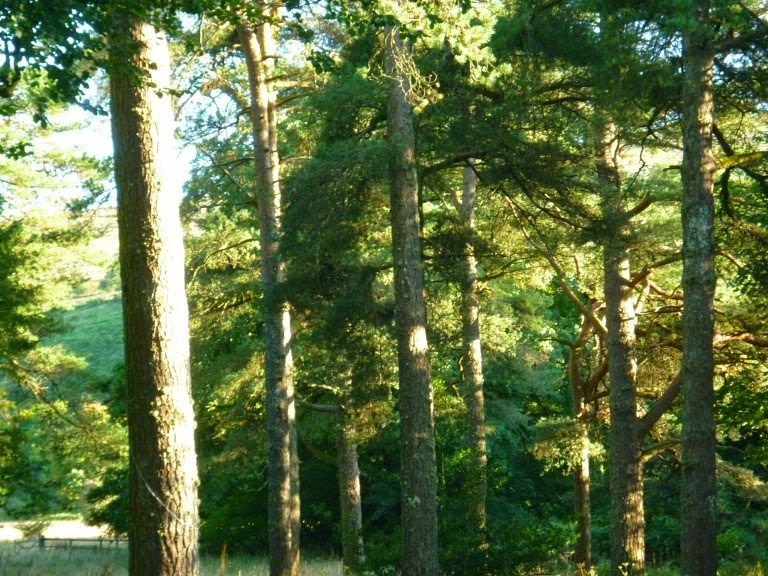
Five views of Dartmoor including Marcia at Bonehills.
Just as special, but completely different thanks to having a very different geology, is Exmoor. Here the rocks are sedimentary – muds laid down by the silt settling in the seas. They are old: the earliest were being laid down in the Devonian geological age some 400 million years ago. Over time, these were distorted by two crustal plates (one to the north, the other to the south) drifting towards each other, pushing the layers of rock up to form an east to west ridge or arch-like fold. That is, of course, an over-simplification: over time there were all sorts of minor movements superimposed on that basic fold and some of the resulting contortions can be seen where the moor meets the sea. These rocks contain no fossils.

For about 200 million years this area was above sea level but during the Jurassic Age (from about 210 to 145 million years ago) parts of this moor was again covered by the sea. The sediments laid down during this period are full of fossils and are very similar to those on the south coast of Dorset which is known as the ‘Jurassic Coast’.

Then there was more shoving and heaving and, of course, constant erosion due to water aided and abetted during the ice age. Was this moor covered by ice? Probably not permanently in the way we think of the ice shield but there is evidence of the surface being repeatedly frozen and then thawed: with shards of frost-broken rock scattered down the hillsides and jumbles of unsorted fragments lying in the valley floors. All of this creates a very different landscape to Dartmoor. Rarely do you see exposed solid rock except on the coast (which is truly one of the most spectacular coastlines in the country). Instead you have softly rounded hills with deep valleys formed by streams and rivers cutting through rocks very much softer than the granite on Dartmoor.


Five views of Exmoor - with Marcia somewhat dwarfed by the landscape.
Then there is Bodmin Moor. Here we are back to granite again but this moor is much smaller than Dartmoor and, to my eyes at least, there is a bleakness about it – probably because, like so much of Cornwall, there are far less trees than there are in Devon.


And here we are on Bodmin. The second down is rather interesting. Marcia wanted to set a house (this was in The Way We Were) here on Treswallock Down. I was saying there was absolutely no reason why there should be a house up here - full stop. Then we came across this hut circle and Marcia, quite reasonably, pointed out that if people had been living here about six thousand years ago then there was no reason why they couldn't be doing it now. So it was that this is the exact site of Julia's home and I had to come up with the best possible reason for it being there. Oh, and that's her in the next picture down near where she set Mellinpons in Postcards of the Past.
One thing they all have in common: if you know where to stand and which way to look from Dartmoor and Bodmin you can catch glimpses of the sea; on Exmoor they are hardly glimpses: the northern boundary of the moor is the Bristol Channel or, as some call it, the Severn Sea.


I am sure you will all agree that we really do know which of these moors we are on when reading Marcia’s books. I am not sure how she achieves this but somehow she manages to evoke the differences in her wonderful descriptive passages and with only one exception (as far as I know) all the books are true to the geology of the settings. I will explain how that error crept in next week and I have to admit that this was entirely my fault – not hers.

Friday, 13 February 2015

Rabbits

Rather like last week, we have been simply busy getting on which is probably the best thing to be doing at this time of the year. Flanders and Swann (do you remember them?) included in their repertoire an excellent little ditty about the months of the year: A Song of the Weather. The couplet that described February runs thus:

February’s ice and sleet
Freeze the toes right off your feet.

Certainly true here and so there has been little incentive to go out and potter around instead of staying tucked up warm and cozy at home. So it is that I find myself following the same tack as I did last week and talking about my explorations associated with the book about Tavistock and another alley I found my self following which has almost nothing to do with what I am writing about but which I found surprising and slightly compelling. It is about rabbits.

This photograph was taken on Bodmin Moor about a mile from the setting of the house called Trescairn in The Way We Were. It is actually in a field that abuts open moorland and these rabbits seem to be managing well. The soil here drains far better than it does on Dartmoor.
 Have you noticed the crow, top left on the skyline?
When I was a youngster, we lived alongside one of the old English estates which consisted of three farms, plenty of mixed woodland and, although no longer used as such, a deer park. We were allowed to roam wherever we liked once we had proved ourselves to be responsible members of society which we did in various ways. Mine was to become friendly with the gamekeeper and I owe to him rather than anybody else my interest in the flora and fauna of our wonderful countryside. There is, of course, no such thing as a free lunch and I had to be helpful in various ways in order to be able to spend so much time with him.

One of those ways was to take part in the never ending attempt to control the rabbit population on the estate. Sensibly the rabbits favoured places where woodland met farmland, preferably with the field to the south of the wood. They were deeply unpopular with the farmers and it really is quite incredible how much damage rabbits can do to crops. So, when matters got out of hand, I would find myself with Mr Brinkley on a rabbit cull. That evening I would return home with two or three rabbits and my mother would make a wonderful rabbit pie.

It was only when I started thinking about the Tavistock book that I gave a thought to rabbits on Dartmoor. They are few and far between: to be honest I don’t think I have ever seen one up there. In the fields that border the moor, yes: on the moor itself, no. A bit of investigation into the habits of rabbits and I found out why this was.

First and foremost rabbits need to be able to dig burrows. These create spaces in which rabbits can socialise and where they feel safest. Obviously these burrows need to be dry and the soil in which they are dug reasonably friable and stone-free and not too far away from a reliable food source. Take a quick look at Dartmoor and all you will find is the reliable food source. The soil is acidic, very peaty (dry it most certainly is not as peat retains moisture) and carries far more than its fair share of stones.
I took this photograph in May 2013 but neither of us can remember where.
Meanwhile, rabbits were then very important and not just for their meat – then a great delicacy and so eaten only by the wealthy – they provided the fur used to trim clothing and, when felted, to make hats. Nevertheless, breeding rabbits for meat and fur was at the expense of damage to crops but there was a simple solution: create artificial warrens up on the moor which provided the rabbits with the perfect environment in which they could prosper a long way away from any farmland. So, starting in about 1300, that is what they did.

In simple language, they chose a flattish area near the top of a rounded hill, dug a trench around it – an ellipse which could be up to a hundred and thirty foot long and thirty foot wide. Next was a long ditch that ran down the middle of the ellipse, a number of cross ditches that linked that long one to the first trench (never opposite each other but I have been unable to find out why) and, finally, a ‘gripe’ or drain was dug to take the water away from the burrow. These trenches were then covered by turf and stones to support a thick layer of suitable soil which created the burrow. Last of all this was then roofed with further turf to keep as much water out as possible.

Here is how William Crossing put it in his Guide to Dartmoor: The burrows, or burys, as the warrener calls them, are formed by first digging a narrow trench, with small ones branching from it on each side, but not opposite each other. Large slabs of turf are then cut, and with these the little trenches are covered. Over this is heaped a mound of earth, and the burrow is finished. A few holes are made for the rabbits to enter, and they quickly take possession of their new abode.' (Incidentally, Crossing lived in South Brent which is featured in The Courtyard and is one of the many villages in which Marcia and I have lived).

Thus, after a great deal of effort, the perfect solution was found. These burrows – now known as Pillow Mounds and often wrongly thought to be burial mounds – provided ideal conditions for the rabbits away from the farmland and, most importantly, the warreners knew exactly where they were and how to catch them.
We were delighted to find that there were rabbits in the field behind the house when we moved into Dartington Hall. Then one started to come into the garden and not everything he (or she, of course, as the case may be) did was entirely to our liking: I can confirm that rabbits love pansies!
Not that it ended there: almost every year the burrows needed work to be carried out to ensure that the drainage system and the roof were in good order but it was all well worth while.

In 1800’s there were eighteen such warrens being operated on the moor – of which nine were in the Tavistock area – and each warren contained anything up to twenty Pillow Mounds. It was highly profitable: in the 12th century a rabbit and its fur cost far more than a skilled craftsman could earn in a day. Gradually as supply built up the prices dropped: by the 15th century it was down to what our craftsman could earn in half a day and by the 18th century rabbit meat was in the grasp of all but the very poorest.

Amazing where a book about Marcia’s books can take you, isn’t it?


Friday, 6 February 2015

From Tavistock to Venice via Leipzig

There really is nothing to tell you about what we have been doing over the past week since the answer is, quite simply, work a lot and (when we remember) grab something to eat. Marcia is now well into the book but is still running well behind her normal schedule and it has become imperative that she can remain absorbed in that ‘other world’ in which her characters live. People don’t realise how difficult it is to return there after an interruption. A telephone call can spell the end of writing for that day – which, of course, triggers off the one thing from which all the writers I know (including me) suffer: fear and despair. There, always lurking, is the gremlin that says, ‘That’s it. The end. You have used up everything and there is nothing left. You know that what you are writing is rubbish. Give up while you are ahead.’

That is not my problem this week as I am not really writing but spending my time researching. I am working on Marcia Willett’s Tavistock and have been looking at the various ways in which the town has earned a living over the last thousand years. Have I ever mentioned in a blog that Tavistock was (well, is I suppose but the functions no longer exist) a Stannary Town – one of four in Devon?
The four Stannary area boundaries (Tavistock, Chagford, Ashburton and Plympton) meet here, at Crockern Tor not far from the Two Bridges Hotel. Accordingly it was here that the Stannary Parliament met when summoned by the "Lord Warden of the Stannaries" - a man appointed by the king who held ultimate responsibility of tin mining in both Devon and Cornwall.

The name comes from the Latin for tin and the reason that these four towns were granted a Stannary Charter (by Edward I back in the early 1300’s) was simple: he wanted to ensure he was able to get the maximum possible tax out of the tin mining industry on Dartmoor. These charters did two things: they enabled the miners to create their own laws (which they had been doing for ages anyway but now these became official) because he wanted to encourage tin production. After all, the more tin that left the moor the higher the potential tax take. The charter also decreed that all tin had to pass off the moor via the appropriate Stannary Town where it would be taxed. It was a brilliant way of dealing with the matter and functioned well for nearly four hundred years, only ending when it became uneconomical to work the remaining deposits of ore.

Since tin mining itself is not really part of ‘Tavistock – Past and Present’ I decided that I would deal with tin mining on the moor as a side bar within that section and settled down to find out all I could about it. In the old days when I needed to research for some cod history (for I am not an academic historian and have never claimed to be one) I have turned to reference libraries and, in particular, the Westcountry Studies Library in Exeter. That no longer exists and has become integrated with other resources to form the Devon Archives and Local Studies Service which is wonderful since a good deal more information is now available on line.

So it is that instead of searching through drawers of record cards and microfiche film I now spend my time trawling through various web sites. However, one thing remains exactly the same: I am unable to stop myself being drawn down all sorts of irresistible by ways which have little or nothing to do with the subject in hand.
All over the moor you will find evidence of tin mining. Often this is no more than the ground having been disturbed in an apparently random way, as here.
Exactly that has happened over the last three days. All I wanted was some old illustration of tin miners at work (a picture being worth a thousand words). I was at that point where the temptation to give up (after all, such an illustration is not really vital) when I spotted a name that meant nothing to me at all: Georgius Agricola. The only Agricola I had heard of was a Roman Emperor but clearly here was someone else since this one was born in Saxony in 1494. Intrigued I Googled the name and within minutes I had exactly what I wanted: some engravings (presumably dated about 1525) which were contained in books this Agricola had written about mineralogy. Then, of course, I wanted to know why this man from what is now a part of Germany had written such books.

He was a true man of his times: a polymath and quite extraordinary. I have been unable to find out who his parents were nor anything about his childhood. However, he comes out of the woodwork in 1514 when he is studying classics at the University of Leipzig. In 1518 he starts teaching Latin and Greek in a school in Zwickau – one assumes he needed the money – but after four years he returned to the university to study medicine. At that time, Leipzig was at the centre of the theological debates out of which sprang the Protestant movement: in July 1519, Martin Luther arrived in the city to take part in what was known as the Leipziger Disputation and the whole university was taking sides; much to the disgust of Agricola who was a staunch Catholic.

To get away from this atmosphere he travelled to Bologna in Italy where he resumed his studies into medicine whilst also studying philosophy and natural sciences: the polymath was coming out of his shell. After further studies in Padua and Venice he took a job with a publisher there: the Aldine Press. Together with another man, John Clement, he was preparing for publication an edition of a book by Galen (the Greek physician) which was published in 1525.

It seems likely that these two men, Agricola and Clement, spent a good deal of time together outside work. Clement had been secretary to Thomas More whilst More was writing Utopia. Was it this book that inspired Agricola to interest himself in the laws and traditions of tin miners? Probably because interest himself he certainly did.

In 1526 he was to return to Saxony where he became the town physician in Joachimstha – in one of the richest mining districts in Europe. It is suggested that his main concern at that time was to find medically useful ingredients in the various ores and metals being mined. In this he was disappointed but his contact with the mines and the miners became his passion and the study of mineralogy was to lead to a number of books on the subject (whilst Agricola was in Venice, he had met the great Erasmus who wrote the introduction to Bermannus; sive, de re metallica, a treatise on mineralogy which came out in 1530). It was to be followed by many others and Agricola was to become known as ‘the father of mineralogy’.


So, after spending time – or wasting time depending on how you look at these things – finding out more and more about this person, in reality all I achieved was to find a few engravings of which one (above) will be used in the book I am working on. Unless, of course, I decide to devote a bit of space to Georgious Agricola which might or might not be a good idea.


What do you think?

Sally Gingerbread, Jeanne and Keith Giles's beloved dog, died very recently and it seemed fitting that there should be a photograph here in her memory.

I understand they are looking to take on another rescue dog and I am sure you will all join me in hoping that they will soon find another companion.

Friday, 30 January 2015

Ashburton

One of the towns that plays a minor role in the book Marcia is presently writing is Ashburton. The first time this town is mentioned in one of her books is in Starting Over for it is where Annie lives. You may remember the paragraphs in which we first meet Annie.

Annie Grayshott replaced the telephone receiver and looked with distaste at her cup of cold coffee. Poor Frances had been talking for nearly half an hour and Annie felt quite numb with the effort of listening. She poured away the coffee and stood for some moments at the window, gazing out over the rooftops of Ashburton and wondering if the situation with Hugh was really as dire as Frances related. After all, Frances was not the kind of person to dramatise herself so why should she, Annie, imagine that she was exaggerating.
     'I suspect,' she said aloud - the fact that her husband, Perry, had died did not prevent her from continuing to communicate with him - 'that it's wishful thinking. I simply don't know how to help her and it's making me feel inadequate and useless.'
     'She needs to get it out of her system.' Perry's shade was, apparently, hovering near the drinks cupboard. `I diagnose a sense of humour failure, my darling. You know my prescription for that. You need a drink.'
Annie sighed and decided to take his advice. She poured herself a large whisky and stared speculatively at herself in the glass that hung beside the window. Her jaw length fair hair had a generous streaking of grey and her tanned skin was especially lined around the eyes but she might have passed for a few years less than the sixty allotted to her.

One of the best reviews written about Marcia described her as “a cross between Jane Austen and Blake Edwards”. I think you will agree that the extract above confirms that view. What is quite extraordinary is that it appeared in Le Figaro.

The Ashburn, having tumbled down off Dartmoor, is now winding placidly through farmland just north of the town.
Back to Ashburton – the town on the banks of the Ash Burn. It is an old community (recorded in the Domesday Book) and was for a while an important one: situated on the main trackway from Exeter down to Cornwall and on the edge of Dartmoor it was important for the sheep and wool market and as one of the Stannary towns where tin was ‘coined’ so that the crown could levy a tax on its production.

And here it is running beside the green. Placid in this photograph, like all moorland rivers it is a different matter when it is in spate. Then it fills this channel and has been known to overflow onto the green after especially heavy rain.
Obviously as these two trades diminished, Ashburton became less important even though it was one of the ‘stages’ on the route from London to Plymouth. This continued to bring in trade until the arrival of the railway resulted in the demise of the highly colourful and romantic but extremely uncomfortable stage coaches. It was finally converted into a bit of a backwater when a new road was built to bypass the town (it being demonstrably not suited to much motorised through traffic) in the 1930’s.

The main road running through Ashburton. You can see why it was that a by-pass was built as soon as the motor vehicle became popular.
When Marcia and I lived in Avonwick we would drive up to Ashburton, buy our supper from one of the best fish and chip shops that I know and take it up onto the moor near Buckland Beacon to eat it. This became quite special when it coincided with a full moon as we could then watch it rising over the sea beyond Teignmouth.

There are no modern buildings in the centre of the town and no large supermarkets. It is a delightful environment in which to do your shopping.
I have been thinking about Ashburton because I am researching the history of the Stannary Towns (for the “Marcia Willett’s Tavistock) which are Ashburton, Chagford, Tavistock and, later, Plympton. As the name implies, this is about tin (stannum) and the usual need of the government of the day to raise taxes on anything that moves or, indeed, does not move.

This magnificent Methodist Chapel stands as a silent witness to Ashburton's wealthy past.
However, collecting taxes is expensive and the cheapest way is to get someone else to do it for you in return for something to make that worth their while. Hence in 1305 Edward I granted Stannary Charters to the first three (Plympton had to wait until 1328) whereby in return for collecting tin coinage (as the tax payable was called) these towns were granted a monopoly on all tin mining in Devon, a right to representation in The Stannary Parliament (which determined the rules and regulations which bound the tin miners) and control over The Stannary Courts (which dealt with breaches in the rules and disputes between miners).

This rather suggests that tin mining here started about seven or eight hundred years ago. Far from it: tin mining was known here during the Bronze Age somewhat earlier than 2,000 BC.

None of which is mentioned in the book Marcia is writing: the only connection being that one of her characters has his office in “Ashbucket” as it is often called here and hereabouts.

There is a rather convoluted link that we have with Zula, seen above expectantly awaiting Christmas dinner. As some of you know, Marcia's son attended Mount House School in Tavistock which, as a result, features in some of her bools. In his day the headmaster was the late Tony Wortham who was to become a great friend after he retired. His successor was Charles Price who also became a friend and who is now also retired. This cheeky Patterdale belongs to Charles's daughter and I am very pleased to be able to share this photo with you.

Don't forget that I am always in the market for pictures of your pets.


Friday, 29 August 2014

The Week in Pictures


This has been an odd week. Falling down the stairs was not a very clever thing to do and i am afraid it took a few days before I was back to normal (if my usual state can be described as such).


First thing in the morning on Saturday the light between the trees in the garden and over the fields was rather spectacular. Most of the day was spent doing very little and feeling quite miserable (but rather bucked by the nice comments under last week's blog) so when Marcia suggested she drive us up onto Holne Moor, I jumped on the idea. It was lovely to just sit there and let her take the strain.


By the time we were up on the tops near Combestone Tor (Forgotten Laughter country, of course) the evening sun was creating those lovely long shadows that bring the countryside to life. I love this part of the moor where there are little fields bounded by stone walls - built thousands of years ago using nothing but muscle power - in stark contrast to the open moor that surrounds them.


We went as far as the bridge over the Dart at Hexworthy where we stopped for a cup of coffee. As you can see, the river was running very low but that should not have been a surprise as we have had so little rain. 


Since I had started the day with a photograph of the morning sun shining through trees, it seemed only right and proper that I also took one of the woods by the bridge lit now by the evening sun.


The heather is beginning to come into flower on the moor. This is the brighter and rather larger Bell Heather which often grows in amongst the gorse (we also have the smaller and more muted Ling). When the sun is shining the gorse's brilliant yellow sets off the gorgeous deep red of the heather. We were a bit too late so this photograph is rather muted. Still nice, though.


The dry summer has resulted in the reservoir at Vennford being lower than I have seen it for many years.


Driving down off the moor, the last of the sun's rays caught the tower at Buckfast Abbey.


Tuesday and we had to pop into Totnes to stock up on some food. Clearly someone else had the same idea - a young gull (probably a young herring gull) eating out of a dish with "CAT" on the side. Was he (or she, of course) stealing some offering intended for a moggie or is some kind hearted (if misguided) person deliberately put out food for him/her?


Also in Totnes on Tuesday was the man who sells a production of his own called The Bag Issue. For seventeen years he sold The Big Issue - a weekly which is produced by a group of that name which helps the homeless. Sellers of The Big Issue receive half the price for every issue they sell and are encouraged to use this experience as a stepping stone to finding more permanent employment and a home of their own. Why the gentleman in the top hat no longer sells that one and has created his own paper is a long story. Suffice to say that you do get a bag as well as the latest issue when you buy a copy from him.


When Marcia did the laundry over the week-end she was a touch over zealous: not only did she load the washing machine with our dirty clothes, she included my mobile phone. Now, there is no question but that after many years of faithful service this piece of (once modern) technology was in great need of cleansing. Sadly, however, it was unable to survive the event although we were able to rescue the SIM card. Thus it was that on that Tuesday, I found myself in our local mobile phone shop where Matthew helped my choose another model. It is quite simple but it has two features I really like: it closes (which means no more accidental calls thanks to the interaction of keys and mobile in my pocket) and it has a big screen which I find easier to read. Thank you Matthew.


While we were sitting outside The Brioche drinking a post-shopping cup of coffee, a car pulled up alongside us and this little person was left inside - agitation in every pore. The photos were taken through the glass so are not very good but I hope you will agree that three pictures are worth three thousand words.

Friday, 27 June 2014

Friendships.

This week my blog is written by Marcia.

Friendships

On Wednesday I drove across the moor to meet friends in Tavistock. 


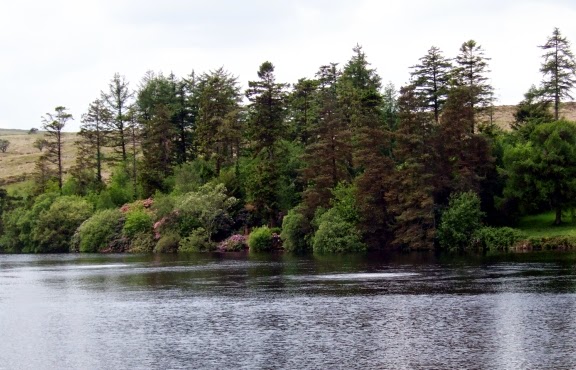
It was a quiet, grey west-country day: drifting mist obscuring the distant tors, ponies grazing with their foals, the rhododendrons at Venford Reservoir a dim, fading pink. As I reached North Hessary Tor the cloud thinned and a watery sun gleamed through and, by the time I arrived at The Bedford Hotel, the sky was clear and blue and it was promising to be another hot morning.


For more than forty years I’ve been meeting friends in the Bedford Hotel. When Charles was at Mount House School I’d take him there for exeats - when it was too far to drive back to whichever naval port we might be stationed at - and always with our golden retriever, Cassie, who was made very welcome at the Bedford. All our dogs have loved going to the Bedford; hurrying up the front steps in the expectation of seeing an old friend, settling under the table in the corner by the window, pricking ears or giving an appreciative thump of the tail when one of the staff appeared with a bowl of cold water.


This morning I was meeting Jean for coffee. Some people say that it’s not possible to make close friends when you’re old. It’s not true. I’ve known Jean for six or seven years; she came to help muck us out at The Hermitage but after a very short while she became a very close and special friend. What is that rare dynamic, that odd, instant recognition, that makes someone a ‘kindred spirit’? She’s much younger than I am, our life experiences have been quite different, but it isn’t relevant: we are on that same wavelength that surmounts those barriers.


We shared our news, we laughed a lot, we enjoyed the coffee – then we parted and I went to meet Carrye at ‘CafĂ© Liaison’ on Church Path.

I’ve known Carrye for forty-two years; we were young naval wives together. At Carrye’s wedding (our husbands were on the same submarine but I’d known her for only a few short months) Charles, who was then two and half, disappeared during the reception. When I found him he was sitting amongst a pile of her half-opened wedding presents thinking, no doubt, that Christmas had come again. Carrye was amazingly gracious about it! I am godmother to her daughter. We have a shared past embracing married quarters, Summer Balls, loneliness, silly in-jokes, divorce, bereavement . . . Lunch lasted for over two hours.


The journey home was through a very different landscape: a brilliant sky, the high rocks clear and sharp. I stopped below Cox Tor, reluctant to leave one of my favourite places and an inspiration for so many of the books, and bought an ice-cream. In the far distance I could see the gleam of the Tamar and, beyond that, the sea. How often I’d walked here with Charles and Cassie all those years ago.


I finished my ice-cream and as I glanced again towards the west I though I saw a small boy playing with a golden retriever, chasing a ball and running in the sunshine, but the sun was dazzling in my eyes and, when I looked again, they’d gone.

My best to you all and thank you for being such loyal readers.
Marcia


Last week I had to pop into our local garden machinery place and one of the chap's there has with him a young puppy. Neither of us could resist him so here he is chewing Marcia's scarf.

Friday, 22 November 2013

Cows' Week - no, NOT Cowes Week - Cow's Week

I am married to a very odd girl. Generally speaking, she likes “small”. If we are eating out she will always ask for a small portion and if - in a moment of misguided generosity - she is given a plate filled with food her appetite immediately evaporates. She likes small corners, too - usually writes in a small corner and did so even when she had a splendid study. One of her “small” things is a beautiful cut-glass wine glass which belonged to her mother. It holds less than half a normal wine glass but she is quite happy with that and uses it whenever we have lunch at home. Now, after all these years, it has developed a crack and so next time we find ourselves in Totnes on market day, I shall be on the lookout for a replacement. Fingers crossed.

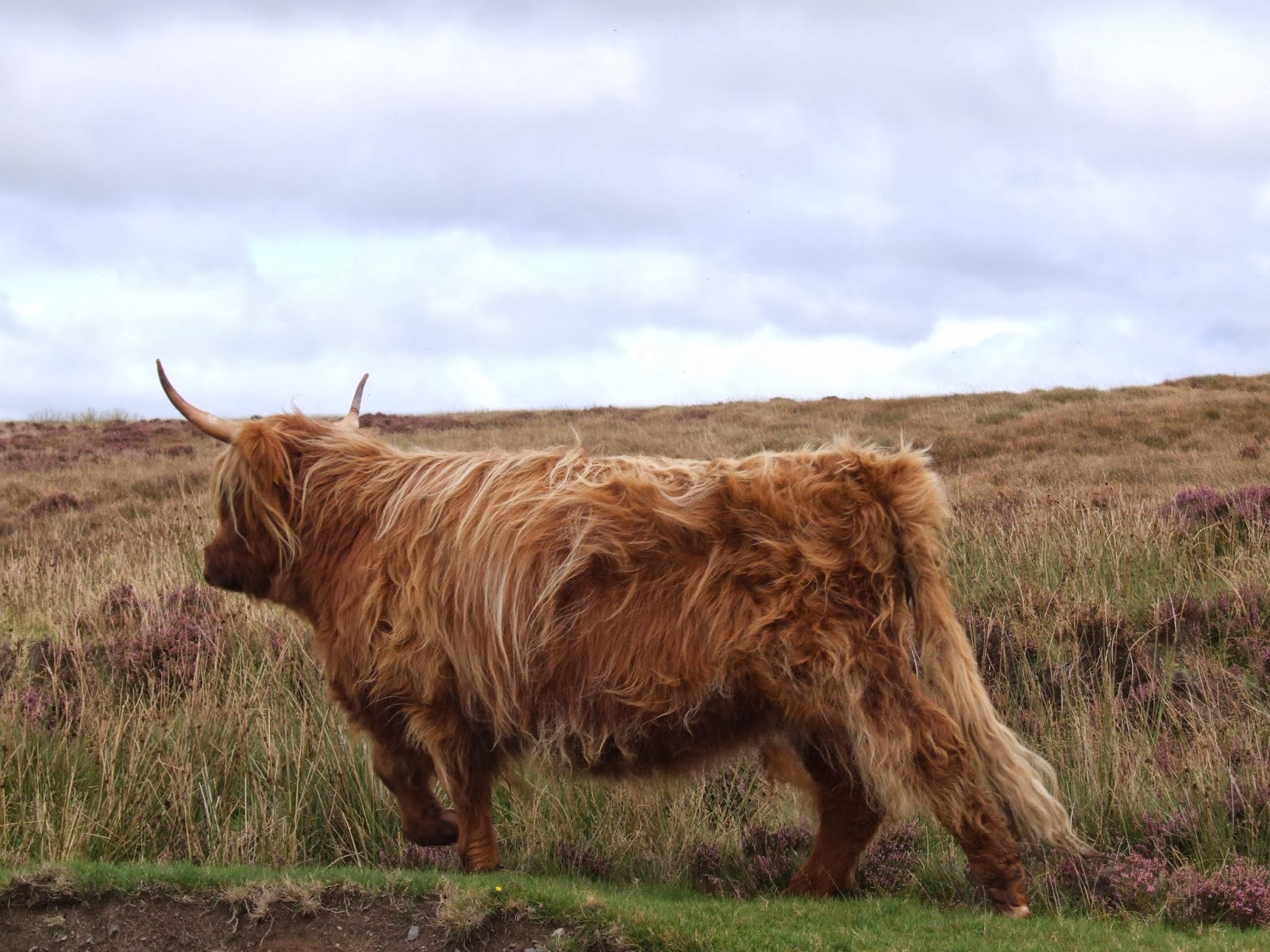
However, there are some things that she likes which are far from small: the obvious example is her love of Newfoundland dogs. There is another big animal that has been a part of our lives for many years: highland cattle. When I say "part of our lives" please do not get the idea that we have ever owned one of these magnificent beasts or anything like that. No, our involvement has been passive: simply watching and enjoying them. Back in the day the only place I remember seeing them was in the fields then farmed by the prisoners at H M Prison at Princetown on Dartmoor.

The prison farm was started about two hundred years ago and covered about one thousand six hundred acres and provided work for about sixty prisoners. It was a stock farm with something in the order of eight hundred ewes and four hundred head of cattle of which about a quarter was a milking herd. This herd supplied the prison and the factory at Lifton where Ambrosia creamed rice is produced which took over two hundred gallons of milk every day. There were also Blue Greys, Galloways and (for milking) Friesians.

Then, to my dismay, I learned that this activity was to cease and all the highland cattle would be sold off. That was nearly ten years ago but I need not have worried. Now, instead of being confined in fields these Highlanders are free to roam the moors and, as you would expect, they are supremely suited to that environment. Since their release (if that is the right word), I have taken a couple of hundred photographs of them and I thought it was time to share seven of them: one for every day of cows’ week! 


Oh, I also have nearly as many of the gorgeous Belted Galloways as well but they will have to wait for another day.


You keep watch down the hill while I ...