Showing posts with label Rodney Willett. Show all posts

Friday, 31 January 2014

A beginning, a middle and an ending

For starters – I owe you an apology. Last Friday one of those Google thingies where they ask you whether or not you want to take advantage of something popped up. I do wish they wouldn’t do this. Anyway, I was busy and wasn’t really paying attention and I hit the wrong button. The result was that G+ snaffled the comments on the blog which meant that you couldn’t leave your thoughts except through G+ (which, as far as I am concerned, is a very bad idea). It was drawn to my attention about six last Friday evening but then took me a while to sort out what had happened and a bit longer to find our how to put it right. So, if you did try to leave a comment and couldn’t, I’m sorry. I shall be more careful next time Google asks a question. Having said that, I find what Google does is very good indeed so I am not at all anti.

They say that every story should have a beginning, a middle and an end. Well, a few weeks ago I mentioned “the desert” – the middle of writing a novel – so I thought I would look at these three stages from the writers point of view.

Everything you write needs a beginning, a middle and an end. Some of us use devices to make life easier (like always ending with a blog dog) but that is really cheating. So, here goes.


The Beginning.

This is marked by a huge surge of excitement as new ideas form and new characters chatter away in the background. Who are they? Where are they? What are they doing? We dash about in the car looking for them and have as much fun in drawing blanks as we have when we “find” (to use an old hunting term which is, I suppose, no longer “PC”).

Then it is time to start writing and that means setting the scene and making sure that the characters jump off the page so that the reader becomes a part of the unfolding story.

But is there really a story? Is there enough going on here to make a full length novel? Will Dinah, Marcia’s agent, like it? Will Linda, Marcia’s publisher, like it? Will Emma, Marcia’s editor, like it? Will the readers like it?

The excitement is, however, diluted by a sense of terror.


The Middle

The scene is set, the characters are known and we are on our way. Now there is the need to produce about fifty thousand words as we trundle slowly and steadily towards a conclusion. This is the worst part in one respect. It takes huge self-discipline to sit down each day and write for six or seven hours. With any luck there will be breaks but these will be because some little detail is required and a visit to the book’s location is the only way to make sure that is properly recorded.

If this is a desert for the writer, what will it be for the reader? How will they manage to struggle through this middle section?

The sense of despair is, however, diluted by a sense of terror.

The End

Now the whole novel is there in the mind’s eye. All that has to be done is to write it. One is reminded of a comment that Iris Murdoch made to her husband, John Bayley. “The novel is finished. Now all I have to do is to write it down.”

In some ways this is the worst bit for Marcia. “Will someone steal mu computer?” (It wouldn’t matter if they did – I keep the text backed up on mine and on a memory stick which is kept in a very safe place where no burglar would think of looking.) “What if my computer crashed and died for ever?” (Still wouldn’t matter – see above.) “What if something happened to me and I couldn’t finish it?” (Very valid concern.)

So we enter into the manic writing phase. Usually Marcia’s writing day starts with working through what she wrote on the previous day (she calls this “polishing”) and sometimes working right through from the beginning because some later idea needs to be introduced, given a foundation. Marcia calls this “threading”. Both take time and then she will write from between one to two thousand words.

Not during the end. Now she is running on overdrive. No polishing, no threading just writing at break-neck speed – anything upwards of three thousand words a day. Then, when she gets to the end, she can relax and go back and do all the polishing and threading that is required.

That sense of terror is, however, enhanced by this new sense of terror.

It has been said that whenever you go into a writer’s study you can smell the fear and the despair. Well, I know that to be true for the two of us but I can’t speak for all the others.

Does all this apply when you are writing about crime? I shall look into that and report back.


Our blog dog is called Zulu. He is a Patterdale Terrier and was, when this picture was taken, about to enjoy his Christmas lunch. I know it’s a bit late but “Happy New Year, Zulu”.

Friday, 19 July 2013

A ruin

The other day we found a ruin that we did not know existed. We found it by accident. I have a job to do this evening at a place I have not visited for well over twenty-five years and I wanted to carry out a recce to make sure that I had the topography pretty firmly in my head.

This happened to be not that far from where Marcia feels the next book to be written will be set so it seemed reasonable that we should toddle off to have a chat with her people when I had done what I needed to do. So we did. And we got lost.

We often get lost. This is because I see a lane that I can’t remember and find myself wondering what is down there and where it goes and the temptation becomes too great for sanity and off we go. We’re not really lost, of course, because we know where we are more or less. I remember writing an article for Yachts and Yachting (I was then one of their columnists) entitled “You’re never really lost at sea”. This title was, of course, provocative and intentionally so but there is much truth in it. I won’t bore you with the details but it works by drawing a circle around that last place you were when you were last sure of your position – a circle whose radius represents the absolute furthest you could have gone since then. You will be somewhere in that circle and the odds are, if you are a cruising man, that a large amount of that will be land and you know you’re not ashore so that eliminates part of the circle. Then, by various processes of elimination you reduce the “possible” area to a minimum.

Since I knew that to the east and to the south was water (the English Channel), to the west was more water (the Kingsbridge Estuary) and to the north was a road (as opposed to a lane and one with a real number: the A379) I could hardly say that we were lost but we still didn’t know where we were.


Anyway, I’m driving up this very narrow and deep Devon lane when suddenly, and very unexpectedly, on the left there are some steps and the grass at the foot of them has been carefully tended. We stopped – if for no other reason than that I felt the steps were worth photographing. Marcia went up first and exclaimed in delight. There – we were in the middle of nowhere – was this ruined chapel surrounded by a graveyard.


After we returned home, I tried to retrace our steps on the map in the hope of finding out what this ruin was all about. It took ages but eventually I found it but all it says on the map is “Burial Ground”. If you want to see where we were the map reference is SX 796 408. The chapel is on the boundary between two parishes (which may or may not be important). It didn’t take that long to sort out that this had nothing to do with the Church of England. Anyway, after a good deal of fumbling about on Google I managed to find a photograph of it titled “Congregational Burial Ground”.

There are no Congregational Chapels in the area now. There was one in Dartmouth where my paternal grandparents and their family worshiped many years ago but that is now the Flavel Arts Centre which, among other things, now houses the town’s library where my mother worked many years ago.

The hall was named after the Rev. John Flavel, a Presbyterian, who arrived in Dartmouth in 1658 where things did not go that well for him. This from the Wikipedia entry: On the passing of the Act of Uniformity (1662) he was ejected, but continued to preach in private until the Five Mile Act drove him from Dartmouth. He kept as near it, however, as possible, removing to Slapton, five miles off, and there preached twice each Sunday to all who came, among whom were many of his old parishioners. On the granting of the indulgence of 1671 he returned to Dartmouth, and continued to officiate there even after the liberty to do so was withdrawn. In the end he found himself obliged to remove to London, travelling by sea and narrowly escaping shipwreck in a storm, which is said to have ceased in answer to his prayers. Finding that he would be safer at Dartmouth he returned there, and met with his people nightly in his own house, until in 1687, on the relaxation of the penal laws, they built a meeting-house for him. Just before his death he acted as moderator at a meeting of dissenting ministers held at Topsham. He died suddenly of paralysis at Exeter on 26 June 1691, and was buried in Dartmouth churchyard.

So who is it keeping the grass at the bottom of the steps and the graveyard itself in such food order? No idea but I intend to find out and will report back if it turns out to be interesting.


Meanwhile this week we have a diet of dogs – four of them to be precise. We had stopped in the entrance to a field in order to indulge in some coffee when this lot came driving past. All, two- and four-legged were in great spirits but I’m afraid there was too much going on to get their names.

Friday, 28 September 2012

Kate's Kronikles


When we first meet Kate, it is her last day at school and she is saying good-bye to her great friend, Cassandra. Although they do not know it then, their lives are to be inextricably entwined. Both appear in a number of Marcia's books. Just for the record, here are the milestones in Kate's life – indicating in which book the events occur. She was born Katherine Beauchamp shortly after the end of the second world war. In 1957 she was sent to a girls' boarding school on the Quantock Hills where she was to meet Cassandra Mackworth.

Those Who Serve

Cassandra invites her to the 1963 Summer Ball at the Britannia Royal Naval College in Dartmouth. Cassandra is going with her fiancée, Tom Wivenhoe, and it is here that Kate meets her future husband, Mark Webster. Both Mark and Tom are studying at the college and both are to enjoy good careers in the submarine service.

Twelve months later both Kate and Cass are married and Kate gives birth to her twin boys in the September of 1965. She is to spend the next few years watching her marriage fall apart, a process exacerbated by Mark's mental cruelty not just to her but, and this is even worse as far as Kate is concerned, to their sons. Inevitably they separate and, in the March of 1976, she is back in Devon and working in a second hand bookshop. An intense affair with the owner of the bookshop ends when she fears that it is damaging her twins. Finally it is Mark who seeks a divorce, which he does in 1981, and for the next few years Kate is not only lonely but has difficulty in making ends meet as she has refused to take anything from Mark on condition that he continues to support the twins who, like the children of most naval officers at that time, are at boarding school.

Thea's Parrot

One of Kate's friends, Felicity Mainwaring, dies and, much to Kate's astonishment, leaves everything to her. Some eighteen months later she is to meet the famous artist David Porteous who is trying to find Felicity. He is taken aback to find a painting that he had given Felicity hanging on the wall in Kate's house. Gradually he tells Kate all about his relationship with Felicity which he had seen as a mild summer flirtation but she had taken far more seriously. To the surprise of both, they find themselves becoming more and more attached to each other. Finally, in 1991 and between books, they marry.

Apart from a passing reference in The Dipper and a brief flash-back in Starting Over, the next time we meet Kate is in Echoes of the Dance. It is 2004 and life has just dealt her two blows and she is grieving for David and her golden retriever.

Roly, whose son looks after Kate's garden, lives on the northern edge of Bodmin Moor in Cornwall. He is fostering a retriever bitch whose owner has died and he invites Kate down in the hope – one to be fulfilled – that she will give Flossie a home. It is during this book that Roly introduces Kate to Bruno Trevannion. We first meet Bruno and the mini-estate called Paradise in The Golden Cup. Included in Paradise is a row of four cottage, once used by boat builder, and one of these is empty following the departure of a tenant. Kate's house is now far too big for her and she has decided to sell but (and Marcia and I both sympathise with this) has no idea what she wants to buy. To give herself a breathing space, she decides to become Bruno's tenant, a move which is, of course, a drastic down size with the result that much of her furniture has to be left in store.

Now, in Marcia's next book, The Sea Garden, we revisit Kate – and Cassandra. You will, however, have to wait until it is published to find out how life has been treating her over the last four or five years. Furthermore, through some flash-backs, we learn more about what was happening to both girls between leaving school and marrying. Enjoy. 

The River Tamar at high tide on a rather nice day.
We are looking upstream from The Sea Garden.

The Jackdaw Jottings

One slight fear we had when we moved into our tree house was that we would miss the birds that had been such an important part of our lives. Certainly there was no evidence that any visited other than an empty peanut holder that hung on a bracket over the railing around the balcony. This we duly filled and waited – and waited – and waited.

Meanwhile the area was echoing to the harsh contact calls of the local jackdaws who spend their time up at this end of the village. They have a 'lookout' in the form of three tall conifers in a neighbour's garden. From there they fly out on forays, perching on roof tops and chimneys, peering into gutters, and dropping down to grab any small morsel that they can find. No one could possibly miss the jackdaws – or so I thought.

Thinking it would be nice to show you another photograph of one of these enchanting (if irritating) birds, I strolled down to the village with camera at the ready. A middle chap came out of his house, looking somewhat puzzled, and asked me what I was doing.

'I'm taking photographs of the jackdaws,' I explained.

'The what?'

'The jackdaws.' Seeing a look of utter bewilderment on his face I added, pointing, 'Those black birds'.

'Birds? Oh, them.'

Yes, them that you see here is two of them.
Sooner or later I shall take a picture which does not show them in silhouette against the sky. 
Now we are beginning to see more than jackdaws. With a bit of judicious feeding on the balcony we have a blackbird, a robin, a number of blue tits, a few great tits, one coal tit and, much to Marcia's joy because she loves them, a small flock of chattering long tailed tits that now call in twice a day – we have obviously become a part of their daily circuit. 
Blackbird

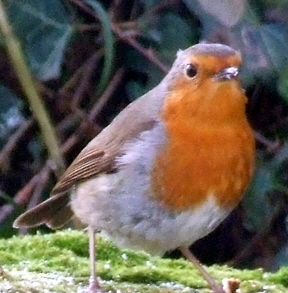
Robin

Blue Tit
Coal Tit and Great Tit at rear

Long Tailed Tit
And, of course, jackdaws.

Friday, 21 September 2012

Cafe society


Sorry but we leave the realms of the novelist's wonderfully descriptive writing and go back to the more mundane reportage of your typical hack.

It being many years since I have enjoyed café society, it has been a great joy to wander into Totnes every now and then and to chill out in bistros such as Rumour or Woods and to meet old friends in pubs like the Bay Horse Inn.
A very old photo of Marcia with Trubshawe (left) and Bessie.
Rumour holds a very special place in our hearts. Many, many years ago when it was still owned by Jenny and Phil, we used to take our Newfoundland dog in with us. Dear old Bessie was a great favourite with everybody and there were no problems for a long time. Then the idea of taking dogs in became attractive to some whose animals were less conducive to the social scene and one evening the atmosphere was somewhat damaged when two such decided to determine which one was 'top dog'. This fracas led to all dogs being banned and you really couldn't object: it is not possible to say 'yes' to some and 'no' to others. There is always a danger in going back after a gap of eleven years: places can be so disappointing. Not so here: the atmosphere remains much the same, our old friend Chris still works there and there is even a Jenny: a delightful and lovely girl.

I do find that sitting in Rumour gets the juices flowing and I have been writing some of my political pieces in there. That has been in an old fashioned reporters' notepad and so they have had to be typed out again when I get back to the computer. Dragging myself kicking and screaming into the twenty-first century, I have ordered an Acer tablet with a 10” screen which divides, one half being a full size touch keyboard (but without the number pad) and the other the bit where what you type is displayed. I will let you know how I get on with it and what other things I can do with it.
The Narrows in Totnes
Woods is new to me although Marcia used to go in every now and then. It is up in the “Narrows” as the top end of High Street is called where, yes, you've guessed, the houses are built very close together. They all pre-date the motor car but even so I can imagine it was a pretty tight squeeze whenever two pack horses going in opposite directions met there.

Most tourists and visitors never go into the Bay Horse Inn because it is right at the top just before the old road, Cistern Street, meets the new which goes by the glamorous name of Western By-Pass. Thus it retains much of the character of a true pub where you will find well kept real ales and cider, some of the town's great characters and a deal of folk singing, jazz and so on.

The town has great literary connections: the bookshop there is owned by nearby Dartington Hall where each year the literary festival, Ways With Words, is held and famous residents included the late Mary Wesley and Joan Brady whose Theory of War was the first winner of the Whitbread Book of the Year Award back in 1993. Both of them were very kind to Marcia when she was first published. It was Mary Wesley who said, on hearing that Marcia had received her first contract, “Many congratulations. You will never be happy again”. She went on to explain that on the completion of the second book the questions would hover in the air. Will my agent like the book? Will my publisher like the book? What sort of reviews, if any, will the book get when it is published? Will my readers like the new book? All very true, and just as true of book number twenty-eight as book number two.

Before I 'sign off' I would just like to wish Gillian, one of Marcia's readers, many happy returns of the day. The sun may not be shining today in Yorkshire but at least it should remain dry.


* * * * *

Jackdaw Jottings

Well, I said I would give this a go. No promises. First up is from an email that Marcia received from in response to my last blog. Here is a small extract.

The weather has been quite autumnal of late with the expected wet weather. We managed to get a second cut of grass & that’s all baled & waiting to be brought in from the fields. Paul’s tractor decided to go on strike (must be a male tractor as it’s very temperamental. . .) but is now back on form & seems willing to oblige with the said bales. The rooks & jackdaws love to sit on top of them, I think it must be a good vantage point for them, but they also like to peck at the wrapping thus creating holes which then lets the water in!! My job is to go round & put tape over all the holes.

Thank you for that. I look forward to receiving other jackdaw stories as I am not sure that the ones we have here will provide enough news to see us through the winter.


Friday, 14 September 2012

Living upside down


This week's blog was written for you by Marcia.

Living amongst the treetops is a new and wonderful experience. Two ash trees grow just beyond the high stone wall outside the kitchen window; their leaves glimmer green and gold in the early morning sunshine, shivering in the breeze. A group of long-tailed tits swing and flutter amongst the branches a few feet from the kitchen table. The sitting-room balcony is hung about with honeysuckle, which holds late flowers and scarlet berries; the slender trunk of a crab-apple tree pushes its way between the wrought-iron railings and its rosy ripening fruit arches above our heads.

...ash trees grow just beyond the high stone wall outside the kitchen window .

...honeysuckle, which holds late flowers and scarlet berries.
...crab apple...its rosy ripening fruit...
 A feeder containing nuts hangs near one of its sturdy twigs and, at last, birds are beginning to investigate: a few blue tits, two great tits and a solitary coal tit. 
...a few blue tits...
A robin hops in to snatch some crumbs and a pair of blackbirds are becoming braver. Jackdaws abound here. 

They peer inquisitively into chimneys and strut stiff-legged along the gutters, discussing life between themselves in harsh voices. One balances anxiously on a roof-ridge, silhouetted against the sky, like a stand-up comic who has forgotten his lines.

Leaf-shadows tremble across the balcony and the Virginia creeper, whose tendrils twine from the west wall across the balustrade, is beginning to burst into flames of bright colour. 

From each room we look across the village roof-scape to the high shoulders of the moor – much closer here – and see early sunlight slipping down the steep eastern slopes and a new moon setting in the west. Rain polishes grey slate roofs with a soft sheen, mist drifts and gathers on the hills until they vanish in thick fleecy clouds. Then the west wind races in, shredding and ripping the clouds apart, and sun slants in through the many windows: roof-lights, dormer windows, the big sliding windows to the balcony, so that the house is full of light.

Living upside down. I love it.

Friday, 7 September 2012

Books and ebooks and book titles


Unpacking boxes of books has become a bit of a pastime recently. I had not realised that there were quite a few that I packed before we left this side of the moor which remained unpacked for the whole ten years or so that we were 'up north'.

That meant there were a few pleasant surprises and none more pleasant than coming across a publication in German which featured two novels: Die MĂĽhle am Fluss (Hattie's Mill) by Marcia and Liebesnest mit Ausblick (Every Woman for Herself) by Trisha Ashley. Anyway, I thought you might like to see the cover so here it is.

Another forgotten book was also published in Germany. This was a Willa Marsh book Die dritte Schwestter or Sisters Under the Skin. The cover is, I think, wonderful so here you have three different “takes” on the same book: English, French and German.


* * * * *

Marcia had gone off to enjoy a reunion lunch with some of her old pals and so, after I had unpacked as many boxes as the old back was willing to tackle, I popped over the the pub for some grub. Being constitutionally unable to eat alone without reading, I took my Kindle with me. As he was leaving, a chap who had been sitting at the next table came over and asked, 'Is that a Kindle?'

Anyway, that chat made me realise that a lot of people may not understand how ebooks and Kindles work so I thought I would explain. If you know all about them, skip the rest of this section.

The Kindle is really a very specialised hand held computer designed to enable you to carry hundreds of books with you in a piece of equipment about the size of a paperback book but very thin.

You can buy a Kindle from Amazon or from Waterstones. You can download 'Kindle for PC' onto your computer (PC or laptop) and then register your Kindle to your computer. That way you can order books from Amazon as you usually do but now you would order the Kindle version of the ebook and it is 'delivered' straight to your Kindle. If you want to be able to read it on the computer, you can do that as well. You will find your 'library' (list of books on your Kindle) on the computer and by clicking on a title, the book will download to the computer and (this is quite clever, really) your computer will know how far you have read it on your Kindle and ask you if you want to go to the last page you have read. Then, after reading some on the computer, when you go back to the Kindle you will have the same option: your Kindle and your computer are 'synchronised'.

What does all this cost? The main outlay is buying the Kindle in the first place. There are various options: the basic one is £69. With that you will also find you can download for no charge (or pence at the most) old books which have long since gone out of copyright: all of Dickens, Conan Doyle and so forth. Books still in copyright (such as Marcia's) will cost you almost the same as the paperback and, yes, Marcia will receive royalties on the sales of Kindle books in the same way as she does when you buy a normal book.

There is no regular subscription: once you have bought the Kindle you pay only for the books you download – which are also available from Waterstones if you prefer to deal with them.

So why did I buy a Kindle? The answer is simple: when I was having problems with my eyes I was unable to read books without using a fairly powerful magnifying glass which was, to say the least, a bore. With the Kindle you can choose what size the text is which made reading once again a pleasure. Now, even though things have settled down and I have reasonably good reading glasses, I prefer reading from the Kindle as it is easier than reading a book. The trouble is that I still love books and absolutely need to be surrounded by them but now quite a few of my collection are duplicated on the Kindle so that I have the best of both worlds – at a cost, of course.

The downside to ebooks is that this new technology is making life even harder for the small independent bookshops who are struggling against cheap offers from supermarkets and online stores such as Amazon. We do all we can to support them and we hope that you will too.

* * * * *

More emails in this week from people very upset – and rightly so – who buy what they thought was a new Marcia Willett only to find that it was one they already had but with a different title.

Poor Marcia gets equally upset but the title is up to the publisher. If two publishers, both publishing in English but in different countries decide to use different titles, there is nothing that can be done about it. We try to make it very clear when this happens but there is another dodge that you might find helpful. Except in the case of an author's primary publisher, you will find that on the copyright page (just inside the front of the book) the name of the primary publisher and, most importantly, the title of the book under which it was first published must be printed.

The same thing applies to sites such as amazon.com in the US where Those Who Serve was published under the title First Friends. If you go to amazon.com and search for Marcia Willett and then click on the cover of First Friends there will be nothing on that page to warn you. BUT, underneath the book illustration will be a link: Search inside another edition of this book. Click on that and to the left you will see another link: Copyright. Click on that and scroll down and there it is: First published in Great Britain by Headline Book Publishing, a division of Hodder Headline plc, as Those Who Serve.

I know it is a bore but if you live in the US and are thinking of buying any book first published in the UK – or the other way round – it is worth checking out as above before you buy. If the first link (Search inside another edition of this book) isn't visible then there isn't a problem.
There is no real reason for this picture except that this is Sea Garden country. It was taken late one evening looking over the River Tamar from the Devon side with the village of Cargreen, in Cornwall, sitting in the shadows. The tide is creeping in and it is as if everything is holding its breath for there is a deep silence: a silence that was broken by the call of a lone gull flying overhead. Seconds later a tractor drove along the road behind us and the moment passed.
Time for a mug of rejuvenating coffee. Marcia has said she will write something for you next week.


Friday, 31 August 2012

Farewell summer


Last day of August. Some might say the last day of summer – and what a summer. It really has been the worst that I can remember: worse than 1947 which was pretty terrible. As you would expect I was at school that year and our sports day would have been cancelled, a wash-out, had the headmaster not been the type to expect things to carry on no matter what the heavens threw at us. He had fought during the war, as had most of the teachers, and considered the slightest suggestion that the boys might be feeling a bit cold or a bit wet as a personal affront – especially if it came from a parent.

Then the summer holiday started. If I remember correctly (and I may not for I was quite young at the time) my father was still in the army travelling daily to his office in the old War Office and so we were unable to go away. I was allowed to do what I wanted and go where I wanted so long as I did not upset the natives (or, in adult speak, our neighbours and particularly the farmers). The parents of the twins who lived next door and who were my particular friends felt the same and so the three of us would meet after we had finished our chores (which, in both cases, revolved around chicken and other matters horticultural) and off we would go armed with some sandwiches to seek adventure where we could. How different life was in those days – I cannot imagine many parents giving their offspring that level of freedom at such a young age.

Anyway, that summer life in the woods , the fields and the lanes was pretty miserable and we spent a great deal of time in the twins’ play room generally bored out of our minds, playing the odd game of table tennis and generally falling out with each other. How important the weather is to us poor human beings!

It has been just as bad for our friends in many other parts of the world. North America seems to be having more than its fair share of ‟weather″ and our thoughts at this time are with all who have suffered thanks to ‛Isaac’.

Having said that, yesterday the sun shone without interruption and it seems we are in for a few more lovely days even though the temperature has dropped quite a bit.

* * * * *


We had a lovely surprise yesterday when two books arrived from Denmark. These are reprints of books (The Way We Were and The Summerhouse) but what we found rather amusing is the fact that the red star carries the legend, ‛A good read’ not in Danish, as you would expect, but in English.

Another arrival this week was the new publication of The Prodigal Wife from Estonia. Marcia has a very soft spot for the Estonians for whom she formed a huge admiration during the ‛singing revolution’ in 1989. We find it incredible that such a small country (less than two million people live there) can support so many book sales.

Friday, 24 August 2012

Holiday? What holiday?


The game plan for this last week and next week was really pretty simple. I suppose “chill out” would have summed it up pretty well. Whatever you want to call it we felt that we had earned a bit of a rest and that it was time for a bit of a holiday. Not a “going away and doing” holiday but a “sit around not doing” holiday.

Fat chance.

For a start we had a completely unexpected and delightful telephone call from our daughter-in-law. She was suggesting that she and our grandson should come down by train to see us. Obviously we were thrilled and we really enjoyed having them here with us but it would be stretching the truth to suggest that it was restful. For a start it meant a frantic couple of days getting their rooms ready. Until that telephone call they were definitely low priority.

Then Marcia received an email out of the blue. The next paragraph is for the sake of those of you who live outside the UK so if you don't and you know the BBC programme 'Countryfile' skip it.

Every Sunday evening, the BBC broadcasts a programme called 'Countryfile' which more or less contains what it says on the label. It used to be devoted almost entirely to farming but in the last few years the emphasis has moved more towards people enjoying what the countryside has to offer. We usually watch it even though neither of us is likely to take part in some of the rather extreme sports they come up with. There are also slots that deal with country crafts – thatching, basket making, hedge laying: that sort of thing – and our wildlife (which, of course, always interests me). They also have a 'Countryfile weather forecast' with an amusing twist. If you have watched the weather forecast associated with the news earlier in the evening, you will see that the forecaster is quite formally dressed: if it's a chap he will almost certainly be wearing a suit. Not so for the one during the Countryfile programme. He, or she as the case may be, will have dressed down: usually wearing jeans in both cases.

Many BBC programmes have magazines (and websites) associated with them and Countryfile is no exception. The Countryfile website carries a great deal of information about what is happening in the countryside throughout the UK as well as about the programme itself. The Magazine tab takes you to a section where you can find out what each issue contains and buy a subscription if you want it to be delivered to your home.

The email was asking Marcia whether she would be willing to write a piece for the magazine which evokes the sense of Devon. You may remember that she write a piece for this blog – Journeys – a few weeks back and she has been using the idea of journeys for this piece for the BBC.

Anyway, because she is already thinking about the next book and expects to start writing that fairly soon, she wants to get this article for the magazine out of the way as quickly as she can. Holiday? What holiday?

Speak to you again next week – if I still have the energy.

Friday, 17 August 2012

Back to work


You might say that this has been week one back at work after the move. On the other hand you could describe it as “week one spent trying to work but actually looking for things that I/Marcia/we knew were in this/that box but which weren't”. I have a rather horrid feeling that week 2 is going to be much the same although most of bits and pieces needed to keep the wheels on the wagon are now to hand.


On Tuesday we went into Totnes: there were a few things we needed to get (or, at least, that was what we told each other). Tuesday in Totnes is faintly odd and bizarre: you will find it described as “Elizabethan Totnes” and there are market stalls manned – or, more generally, womanned – by people wearing Elizabethan clothing (with a few more modern additions). All the proceeds go to charities and many visitors come to the town on Tuesdays, curious to find out what this is all about. 


The Totnes Town Crier is usually on hand to help matters along and, if you are lucky, there might even be Tudor Dancing to traditional instruments.
There is something very Totnesian about this display of boots and . . .
. . . the buskers outside the bank.
It was a nice day, neither too hot nor pouring with rain, spoiled slightly because Marcia left her favourite fleece gilet somewhere and we have been unable to find it. Perhaps it might show up when I throw some more stuff in the recycling bin . . .

This morning we both had long overdue appointments to have our eyes tested. We had been putting this off because we felt it better to wait until after the move and we knew exactly who we wanted to see: the highly recommended optician to one of Marcia's old friends.

Shortly after we woke up, the heavens opened and it started to rain very hard indeed. It was still raining as hard on the drive to Ivybridge and as we rushed from the car to the opticians.


Then the rain eased off so I took the opportunity to dash out and take some photographs of the River Erme in spate. I should have had the video camera with me and then you could have enjoyed the enormous noise this water was making but as it is you will have to imagine that.

Now the sun is shining on the wall outside my study, the rain drops on the leaves of the Rambling Rector Rose climbing the old wall beside the Red Valerian looking like tiny jewels, reflecting all the colours of the rainbow (which, of course, is exactly what they do do).