Showing posts with label Indian Summer. Show all posts

Friday, 10 October 2014

A Tale of two Claires

Titles are difficult - finding a title of a book and then writing the blurb that goes with it seem to be almost as difficult as writing the book in the first place but this title came to me and now you can see why.


The Claire in the top picture has been working at the book shop at Roman Gate in Exeter for as long as Marcia has been writing and so they have known each other for a very long time. In those early days the shop belonged to Dillons (a book store-cum-chain with an interesting history - next week, perhaps?) but it is now one of the Waterstone outlets.
The other Claire, who works in Exeter, is already known to some of you: she takes photographs of moths which she sends to me in the hope that I shall know what sort it happens to be and which I put up om this blog.
What I wrote last week about neonies was misleading although I didn't realise that at the time.

This matter of the use of insecticides is never as simple as it sounds and it could well be that the EU has this one wrong and the UK was right to vote against the ban on neonicotinoids. Th EU argument is that this insecticide damages the pollinating insects that we need – this decision was based on laboratory tests that exposed bees and other pollinators to far higher levels of neonies than they would experience in the field and at those levels it was, not unsurprisingly, lethal.
Marcia with our old friend Peter Kingsman - to whom Indian Summer is dedicated - having a moment in the Bedford Hotel in Tavistock.
The main need is for something that deals with insects such as the flea beetles that can and do destroy the very plants that produce the pollen on which the bees live – crops such as rape – and, crucially, flea beetles have become resistant to pyrethroids (the insecticide that was to be replaced by neonicotinoid) with the result that over half the crop here in the UK failed before coming into flower. This resulted in less food for the bees: many colonies have raised fewer progeny and are in serious danger of being unable to make it through the winter. Thus the ban on neonies has effectively halved the bee population in areas where they rely on farmers to provide them with their food. Isn't life complicated?

My Friday blog is not the place to explore this subject in detail but I thought I ought to put the record right. As I remarked above, this subject (like fracking and a few others) is never simple but there is one common denominator: the debates about them tend to create a lot more heat than light,

As a result, I have been thinking about pollination quite a lot since last week and especially about the way in which plants spend so much energy in producing flowers designed to attract insects. Nature, in this case, is truly profligate as the following photographs demostrate.


There seems to be a parallel here between nature putting huge energy into producing a display that has a fairly short life and writing. It takes Marcia about a year to write a book – and then there is the work carried out by her editors, the copy editor, the production team, distribution network and the booksellers. How long does it take to read one of her novels? Certainly less than a week. The argument gets rather muddled because there are, of course, many thousands of readers and many of those readers read each novel quite a few times.


It has taken about five years to finish Marcia's Willett's West County which is utterly ridiculous when you consider that we are talking about a very slim volume (just over a hundred pages) where about 25% is taken up with photographs. I just hope some of you will enjoy reading it when it comes out. All the files have been delivered to the printer and publication day will be 30 October. This last week has passed in a bit of a whirl as I was determined to finish everything before I went to bed last night. Very pleased to say that I managed to achieve that but everything else went by the board.


One of the casualties has been the garden. It would have been good to have finished “putting it to bed” for the winter while the weather stayed fine but that just didn't happen – the Indian Summer we have been enjoying broke with a vengeance shortly after Indian Summer was published. I blame Marcia.

Sadly I have no idea what this chap is called but there is something about that solid - even stolid - stance of these terriers that always appeals to me. "Come on world," they say, "I'm ready for you!"


Friday, 3 October 2014

The Indian Summer Ends

Why the title? Well, the weather is breaking and now we are about to be plunged into autumn,


May I say how much Marcia and I enjoyed reading your various comments last week. She is, of course, thrilled to feel that she has created characters that readers feel are real (and, being Marcia, never fails to be amazed when people say so). Anyway, just for fun: any thoughts on the way that Honor Trevannion coped with the various predicaments that life strew in her path?

Marcia signing books in the Totnes Bookshop and, below, with Cliff Shephard the shop's manager.
The moth I showed you last week is known as Angel Shades (Phlogophora meticulosa): my thanks both to Joy in Delaware and, on this side of the Atlantic to John Lockwood in Warwickshire for identifying it for me. The adult is no problem but the larva are generally considered to be a garden pest as they feed on a wide variety of foliage and flower buds. So there you have it – do you value your plants more or the occasional and rather delightful moments when you see the adult in all its glory? The Royal Horticultural Society suggests either torchlight sorties during which you remove the larva by hand (and then what?) or using a chemical pesticide. Personally I am rather against using pesticides: in part because it seems simply wrong and in part because you don't know who is harmed by them (including, of course, people).
While Marcia was signing books, this immature herring gull was enjoying a spot of lunch just up the road. Was he stealing some cat's lunch or had someone put this out for him in a cat bowl?
Which leads me on to think about the role of insects generally in our lives – a role that I fear is somewhat overlooked. There has been a collapse in the bee population here in the UK. This matters as bees (and other insects) are vital for the pollination of many of our crops. It seems that the decline started in the 1990's with the introduction of neonicotinoids – a group of pesticides. Although there is no actual proof that these are directly responsible for the population crash, the timing must make it real possibility.

It is, of course, always tricky to be sure as to what causes what since that was about the time when in the UK we started to introduce a more intensive form of agriculture which included monoculture which destroyed many habitats that were bee (and other insect) friendly.

Back in the spring of 2013 the European Union banned the use of certain insecticides – but was that a wise decision? Ignoring any feelings we may have for the insects themselves, it is, I suppose a matter of balance. On the one side is the loss of potential food as a result of damage caused by insects – on the other is the loss of pollinators such as bees resulting in lower crop yields. I am glad that the EU imposed this ban and rather ashamed that the UK voted against it but I think that says more about me than anything else.

Causation: a very interesting subject and one that crops up when Marcia and I are talking about whatever it is we are writing about (be that her novels or some of the hacky stuff I am working on). It rather matters and I suspect that not taking causation seriously enough is the cause of much that is written that doesn't quite work.
The other day we visited the Two Bridges on Dartmoor because Marcia had a feeling that her new group of people might meet there. It was a fruitless trip as it happens - she drew a blank. Meanwhile the hotel's little flock of geese appeared and one of them plonked itself down in a way I have never seen before - so I took his (or, of course, hers as the case may be) portrait.
Why, to take a recent example, did Tristan behave the way he did? Well, by the time we get to the end of Postcards we know the answer to that question. The important thing is that Marcia knew from the outset what made him what he was and so he was, throughout, a fully rounded character. Thus it is that she (or we) delve back into the history of all the people that appear on the page (and quite a few who don't but who would have been an influence on those who do).

This applies not only to the people but to the landscapes as well. I have often mentioned that Marcia will 'see' a given location which will include certain objects – a certain sort of house, plants, a view, a river and so on – and then we have to try to find out why such objects exist where they are placed. In the end (and this is another of those mysteries) it will come together and everything ends up making sense. Getting there, however, can be fraught.

It's a bit like that when I'm writing what I think is best described as 'cod history': chatty and informative but with no pretensions to be taken as serious history. The intention to give a feel of a certain place over a given period of time. First of all, of course, it has to be honest (which means accurate) but after that it all depends on why the history is being written. This is in my mind, of course, because I have just finished the Dartmouth book and am starting on Marcia Willett's Tavistock. Although I have often written and talked about the history of Dartmouth (and a few other parts of Devon including Dartmoor) as it happens Tavistock has not been one of them so I am starting from square one.
Since I expect that most of you are now into Indian Summer, I thought you might like this picture of Haytor.
Going as far into the past as I can I discover that there is a suggestion (I have yet to find definitive proof of this) that there was an earthwork about mile to the north east of the centre of the town which would seem to be about four thousand years old. At the end of the day this earthwork may or may not be mentioned in the book. If it is, it may be no more than a sentence and certainly no more than a couple of paragraphs.

Meanwhile, this small hill which seems to have been built by human hands will occupy my thoughts for some time as I trawl through all sorts of information in books and on the internet in an attempt to answer three questions which are dominating my thoughts at the moment: who built it, what was it and why was it built? All of which is, of course, summed up in one word: causation.

As I write this, Marcia is doing something similar as she probes into the past, the present and, indeed, the future of some of the people occupying her mind. One thing is for sure: unlike my people, none of them will bear the labels of Briton, Celt, Saxon or Norman.

This extraordinarily charming chap answers to the name of Leo. He is a Dutch Partridge Dog – a breed unknown to me. It seems that they are far more popular in the US than they are here in the UK. Having read up what I can about the breed I am sorely tempted – but I shall have to fight the temptation as we really have decided that there will be no more dogs. Honestly. Probably.


Friday, 5 September 2014

Requiem to a tree

We all know that when the wind speeds get up above about fifty miles per hour that we can expect damage – and especially to trees.

It is rather unfair to dig up the past, but those of us who watched the weather forecast on 15 July 1987 will remember a comment from Michael Fish who was presenting the programme.  'Earlier on today,' he said, 'a woman rang the BBC and said she heard there was a hurricane on the way. Well, if you're watching, don't worry, there isn't'. Later that evening we were hit by a violent storm with gusts in excess of a hundred and twenty miles per hour tearing down power lines – and toppling trees many of which caused serious structural damage to buildings as the fell.

This is the earliest photograph of the tree that I have in my collection. It was taken by my sister-in-law in March 2004.
One odd outcome that followed that storm was that, over the next few weeks, the emergency services were sometimes overwhelmed by the accidents to people who, either because a tree was causing them problems or they decided there were opportunities to make a fast buck, bought themselves chainsaws to saw up the timber but, lacking experience, injured themselves – often quite badly.

Early April, 2014.
All of which brings me to the fact that what one does not expect is for a tree to fall when there hardly a breath of wind nor a cloud in the sky. It has happened twice to my knowledge although I did not witness the actually fall in either case.

The last photograph I was to take of the tree, June 2014.
The first time was when we lived in Avonwick and a beech tree growing in the bank beside the lane than ran down the side of the house split in half, one half remaining upright and the other falling across the lane, blocking it but causing no injuries. We had had a period of dry weather and one of the local farmers told us that the rooks had deserted that tree a couple of years before. 'When rooks desert a tree,' he said, 'you know it's in trouble and the best thing to do is to have it down quick as you can.'


Then, the other day, the same thing happened to a pine here in Dartington. Again nobody was hurt. Anyway, the pictures tell the story and, as you can see, the tree is being sawn up. The smaller branches have been chipped and the chips used to create a soft bank over the steps leading to the rough area below down which the larger parts of the tree will be rolled by hand to where heavy lifting equipment can be brought.


Meanwhile I have news of another literary festival. This is on a completely different scale to Ways With Words or any of the other literary festivals. For a start you can attend the literary events (which take place during the day) free of charge although it will cost you five pounds to go along to the village hall and take in a couple of hours of musical entertainment in the evening.


The key to this festival (this is its fifth year) is that it ends up in a village hall. Quote from the website: 'The Charmouth Literary Festival is very much a village affair and we want you to enjoy a day of words and music in a relaxed easy manner, having the added advantage of being located in a beautiful place by the sea. Bring a picnic lunch if you wish, come with a friend or come alone and enjoy a literary day with a little night music.' Anyway, since I rather like the idea of small festivals of this sort, I thought I would tell you about it.

This wire-haired dachshund (a breed both of us love and one we are tempted to try out even though we have said 'no more dogs') answers to the name of Brian - unless, of course, he has other thoughts in his mind in which case . . . 


Friday, 20 June 2014

Devon? Cornwall?

At this time of the year – well, usually a bit earlier than this but we are running a bit late after the move and everything else – Marcia starts to think about where the next book will be set. I feel reasonably confident in predicting that it will be somewhere in Devon or Cornwall but beyond that it would be dangerous to go.

The way it works is something like this. Somewhere in the back of her mind Marcia has one or two characters beginning (her words) to reveal themselves. She is on record as saying that the characters bring their landscapes with them and this is because of what we call a “Clare’s wedding moment”. Like all family catchphrases that is a code that cannot be broken – you have to know what it means. Clare is one of Marcia’s nieces and she, obviously, was getting married and we, as you would expect, had been invited. Getting there was a bit complicated as we had to fetch our son from school in the way. Somehow and for some reason neither of us could quite see ourselves at the church. There was no rational explanation for these feelings – which we both had – but they were quite strong.

The garden is full of young birds pestering their parents to feed them - and parents doing their best to move them on. Here is a young blackbird who, when he grows up will be like the smart guy below.

To cut a long story short, we had problems with the car and so we just made the reception. Ever since, a situation that looks perfectly reasonable but in which one or the other of us simply does not believe is a “Clare’s wedding moment”.

Looking for the landscapes brought by Marcia’s characters usually results in many miles of travel and many such moments until, usually unexpectedly, it all feels right to her and we have found what she has been looking for. Sometimes this is definitely not where she would like the book to be set but you can’t have everything you want, can you?

Probably the most uncanny example was finding where Maudie Todhunter was living. This was before Marcia started writing A Week in Winter – before simple because she could not get going until she could see Maudie in the right environment. You may already know the story: if you do, skip to the last two paragraphs.

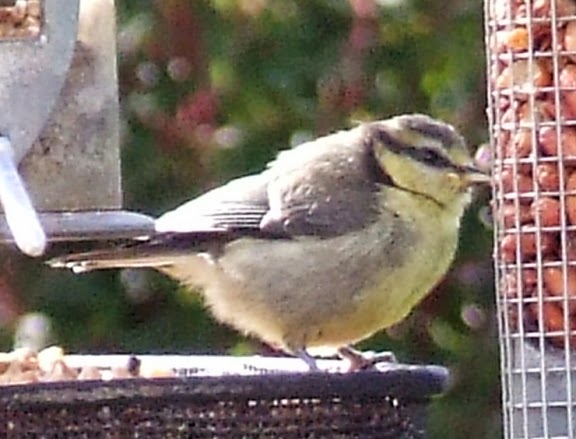
Here a baby blue tit is learning to feed himself. Most young tits have a yellow tinge to their feathers unlike the adults.

It started because I trod on my spectacles and broke one of the lenses. At that time we were living in Avonwick an optician (Vision Express) in Newton Abbot (Totnes is about half way between the two). I rang up and explained the situation. They had a laboratory on site and said that I could have an eye test (one was due anyway) at noon and the specs would be ready a couple of hours later (which, when you think about it, was incredible service). So off we went with Marcia driving. The obvious thing to do was to have lunch in Newton, which we did, and then a bit of shopping that we needed and then, having collected the new glasses, back home (with me driving this time).

Great Spotted Woodpeckers - dad on the left and son on the right. As soon as the boy loses his red cap his father will attack him and drive him away to find a territory of his own.

It did not go according to plan. As we drove out of the car park, I was indicating right that being the way home, Marcia suddenly spoke.

Quick, turn left. I’ve just seen Maudie. We must follow her.”
Causing some little confusion to other motorists, I did just that and, following Marcia’s instructions, drove through the town and out on the road towards Bovey Tracey. Even then it was not straightforward. Having said that she was sure Maudie lived in Bovey, as we approached the roundabout where I was expecting to turn right, she changed her mind and so on we went. About a mile further on she directed us left, down a narrow lane, left at another junction and then, having crossed the bridge over the River Bovey she told me to stop. There, on the left, was a gate behind which was scrub (small trees, lots of brambles and so on).

There, that’s it. Good, we can go home now.”

And we did and Marcia started writing later that afternoon and wrote one of her most poignant stories.

Not everyone, of course, can believe this is what happens. At one of the festivals at which she was asked a question about this business of finding the landscape. She finished her answer with the words, “So, you see it really is nothing to do with me. The characters tell me where they live.”

How lucky that none of them want to live in central Birmingham,” came a dry comment from one of the men in the audience. Clearly he was not a believer.


And so here we are again, setting out on a journey of discovery. It was easier in the days when we did so in our old camper van, taking with us all we needed in the way of refreshment and providing a base from which to wander about and “listen to the characters chatting amongst themselves”. For both Indian Summer and the book which still awaits and agreed title, this base has been provided by cafés and other such places. It was in The Dandelion (a café which is part of the Moorland Hotel below Haytor on Dartmoor) that Marcia sat and brooded – and which features in the book itself. The Brioche in Totnes was also important – and again was to feature in the book. For Untitled it was the shop/café associated with Stokeley Barton Farm Shop on the road from Torcross to Kingsbridge and The Boat House in Torcross itself. Again both feature in the book. If you want to know more about these places, follow the links.

Meanwhile here is Marcia with Anton, one of the people who look after us when we pop into the Cott Inn in Dartington for lunch.


This time? Well, as I have said, I have no real idea but as I write this Marcia is in Totnes and she has just sent me a text. She is having coffee in The Green Café just down the road from The Brioche. I wonder – just wonder. If it proves to be important then we can rule out Cornwall this time around but I doubt it will be that easy. I’ll keep you informed.

This week's blog dog is, very appropriately, called Canuke. He really is a splendid fellow and I just hope that he does not feel homesick.

Friday, 6 June 2014

Book Proofs and Blackbirds


Book Proofs

Reading the proofs of Indian Summer is now a thing of the past. There was one silly mistake I found which was in the manuscript that we sent to Transworld following incorporating all the bits and pieces which came to light thanks to the copy editing (carried out once more by Yvonne Holland who is absolutely first class). This time Transworld have decided to submit an electronic version to the printers rather than to have the book typeset in the traditional way so the only mistakes should be the ones we made in the first place – and so it turned out to be.

Odd to remember that the inspiration for the setting of this book was near St Neats in Cornwall. We had stopped to let Jossie (below) out of the car for a moment and we were standing on this bridge looking down at the little river below and through the trees to the building with its barn when something clicked in Marcia's mind. Mind you, all of this was in the wrong place so the whole lot was (mentally) moved to the edge of Dartmoor behind Ashburton.

The advent of modern technology into the art of writing is both exciting and worrying. Speaking as a simple hack, I find being able to write on a machine that gives me the option of makes changes as and when I want to is wonderful. I remember one book that I wrote where I had considerable problems with one chapter. In the end I retyped that chapter thirteen times and that is something you never forget. It's a bit like proof reading. On the one hand you are bored silly – on the other you have to retain a high level of concentration. But, and there is always a but, it means changes which almost certainly have a bad effect on some people – but, of course, a good effect on others. The obvious example is internet book selling which has hammered the high street bookshop (which we all love in theory but generally do not support in practice). On the other hand, you have a far wider choice on Amazon and they do employ a lot of people even if in an environment that, from all that I have read, I would find intolerable.

The little river and (below) the house with its barn.


As to passing on text files from author to printer and cutting out the typesetter, well it is obviously not good for typesetters. However, if it keeps the prices of books down and so makes them more accessible, that must be good. Incidentally, having done spells of typesetting (as happens sometimes when you edit things in a very small publishing house) I know from personal experience that that is another example of something that is both boring and demanding high levels of concentration.

Blackbirds

The garden is now full of baby birds being fed by careworn and rather scruffy looking adults. It was a peaceful afternoon a few days ago. Marcia had just finished a stint of writing and was relaxing in the garden. I was in the kitchen. Suddenly there was an almighty crack and a baby blackbird crashed into the kitchen door (which is mainly glass). It seems that a springer spaniel (probably the maddest breed there is) suddenly roared up from the lane, rushed around our lawn and then took off again. The people with whom the dog was walking took no notice but not so the birds. They, of course, scattered – and one, a baby blackbird, had come to grief.


It is always difficult to know what to do when a bird is injured. This one was lying on its side, beak open, tongue lolling but still breathing. I picked it up and checked wings and legs: nothing broken as far as I could see.

Years ago I was told that shock can be a killer in these circumstances and the injured bird or animal should be kept warm if possible. Whether or not this is correct I really don't know but I held it for some time until its breathing became more regular and then I put it down on the grass.


It was then, as you can see, sitting upright – or nearly so – which made us a bit more hopeful.

I'm not sure when Marcia realised that the big problem was that the bird couldn't see. Obviously the probable reason was that the blow had been severe enough to detach the retinas in which case there was no hope for it. Also very worrying was the fact that the adult blackbirds, while continuing to feed the other baby, were steadfastly ignoring the one that had been damaged. I have seen this sort of thing before. It is as if the adult knows that there is no point in wasting time and energy on a hopeless case. It was all very depressing.

Anyway, we decided that the best thing we could do was to make him (why did we decide it was a he?) as comfortable as we could and then to keep a watching brief in case he was attacked (crows and cats being the likely threats).

The hours dragged by and nothing happened other than he started to walk. Not being able to see, he was stumbling into things and ended up in a corner underneath a hose reel. Not a good place. I decided to catch him again and put him somewhere safer. He gave off the usual strident “help, I'm in trouble” call of the immature blackbird – and I was immediately challenged by the adult male flying straight at me and letting forward the well known blackbird challenge call.

Even so, with the baby back on the lawn, the adults continued to ignore him.

Then, quite suddenly and without warning, he took off and flew up into a bush. Did that mean he could now see again? It seemed so.

He (or she, as the case may be) reunited with his (her?) brother (or, quite possibly, sister) just outside the kitchen door.
Finally, and to our delight, the adults started to feed him again and he seems to be making good progress although one wing still droops quite badly. Luckily there is no need for these birds to fly very much or for very far.

It is nice to be able to report a success story – nearly every injured bird that I have tried to save has eventually died. Sometimes I have steeled myself and put one out of its misery. Sometimes I have let nature take its course. In both cases I end up feeling rather guilty – it is, indeed, a no-win situation.

Meet Ben.
Not a very good photograph I fear but you can't get them all right. 


Friday, 28 February 2014

On our way to Dartington Hall


We think (hope?) that we have finally found where we want to live. We can't buy the house because it is extremely unlikely that it will ever be sold on the open market. However, we can rent it and do so for as long as we want to stay put - hopefully for a very long time. It is substantially smaller than the house in which we have been perching for the eighteen months or so but that is not a problem as you will see.

The explanation is that the house in question is on the Dartington Hall Estate. This estate - which has featured here on my blog on a number of occasions in the past - covers over twelve hundred acres, includes Dartington Hall itself (where Marcia has spoken at Ways With Words) as well as a couple of schools, a farm, the Barn Theatre, The White Hart (a pub), The Roundhouse (coffee and snacks), the Cider Press Centre (now called Dartington Shops), a number of office blocks and, crucially, lots of houses and cottages. Click here to see more about Dartington Hall.

In addition to the house we are renting a couple of small offices (which is why we can manage in a much smaller house) and earlier today we took possession of those offices and have started to move things into them.

Gosh - even golly gosh. It has all happened quite quickly and incredibly easily which - rightly or wrongly - persuades us that this move was meant.

From the above you will realise that we have been very busy indeed, sorting things out and beginning to pack up ready for the move which will be in two parts: all the rest of the officey bits next Wednesday and then the house stuff about half way through March to give us time to have curtain poles and so on put in place first. So we are in for a fortnight of general chaos and a tumbling of our usual mediocre cuisine which will, I fear, major on quantities of unhealthy snacks and pub lunches during this period.

Fortunately there is one thing we will not have to worry about. The move is so local that we shall be able to stay with our present doctor and dentist which, for some reason, I find quite comforting.

The proposed cover for Indian Summer which will be published in October.
Meanwhile, on the booky front, last night I finished checking through the copy editing for Indian Summer - the book that will be published next October - and the final mss has gone off to Transworld and to Marcia's agent, Dinah Wiener (for the foreign publishers to read).

Dinah has just returned from the island of Bhola, off the coast of Bangladesh, where there is the headquarters of a children's charity - Bhola's Children - of which Dinah is a trustee. The island is not the easiest place to visit: there is an overnight ferry journey which follows the long flight from London and I cannot help but take my hat off to Dinah who, despite being in her seventies, makes this trip at least twice every year.

There is a big problem looming on the horizon for this charity, one we are beginning to see only too clearly here in the UK. The land that the charity has bought on which the hospital and school have been built is very low lying - as, indeed, is most of Bangladesh. There is an ongoing concern that rising sea levels will make this area untenable - and there is absolutely nothing that can be done to protect the island. Here in the UK we are realising that large areas (such as the Somerset Levels here, in the South West) are under attack in two directions: from rising sea levels and heavy rainfall. Now it seems that it is California that is in the firing line as, after months of drought, it is now facing its second torrential downpour: one that forecasters are suggesting will dump two inches of water in less than twenty-four hours. Hmm.

Colin the collie cross will not be going to Spain with the four "D's" (see last week's blog) but will remain behind to look after Debs' mum.