Showing posts with label Tavistock. Show all posts

Friday, 6 March 2015

Tavistock at work 200 years ago

The problem with looking into the history of a place is that sometimes you end up with a feeling of total disconnect – a feeling that the place you know so well could not possibly have been anything like what your research tells you.

Less than two hundred years ago Tavistock was completely and utterly different. It was an industrial town which depended on people to provide most of the power needed to drive that industry.
One thing is certain, 200 years ago there was no Book Stop. It was here, as I am sure most of you know, that the launch party for Marcia's first novel Those Who Serve was held. That was a long time ago but the book is still in print and continues to sell in both print and ebook editions.
In the early 1800’s copper in considerable quantities were found in and near Tavistock. This simple fact had a huge impact on the townspeople in general but what I want to talk about is what happened to numbers of young girls and women: they were employed in the copper mines carrying out filthy, back-breaking work all of which started when they were no more than thirteen years old.

No Bedford Hotel . . .
They weren’t employed underground (or, if they were, there is no record of this happening) but it was their job to carry out all the work needed to convert the ore bearing rocks and detritus that was dug out below and brought to the surface. The whole process was called ‘dressing’ and the areas where most of the work was carried out were called ‘dressing floors’. Some were covered, others were in the open air.

No Crebers . . .
First all the material that had been mined had to be taken from the mine head to the dressing floors. This was done by teams of two women using shovels and hand barrows: usually in their twenties because this work demanded great strength.

Next was work for the younger girls: to wash out the rubbish and put to one side the lumps of rock in which there would be copper ore. It was important that these girls neither discarded valuable ore nor allowed useless material to be passed on to the next process. In short it demanded knowledge and considerable concentration. New girls would work alongside those with experience in order to learn the job and all day their hands – and often their clothing – would be wet as they carried out this physically demanding work: they would be lumping around pieces of rock that could weight up the thirty pounds or so all day long.

No Duke Street . . .
All this work built up their strength and they would be moved onto breaking up the rock and turning it into a powder. This was done in two stages. The first used short and heavy club hammers to break the rocks down to the size of pebbles – the second used flat headed hammers to break up the pebbles and grind them to powder.

Then would be the final stage: the separation of the particle of copper ore from the ‘guange’ (pronounced ‘gang’) which comprised all the bits of stone and so on which were of no value. This part of the job is almost exactly the same as panning for gold – using water to separate out the lighter guange from the heavier metal or ore.

No Pannier Market.
We are talking about quite big concerns: we know that one mine employed over a thousand workers at one time and the other was a somewhat larger operation. That would mean that a third of the town’s population was involved.

Can you imagine what those working conditions were like? Can you imagine any of our youngsters today being prepared to carry out such work?

One thing is for sure: none of Marcia’s characters would recognise the Tavistock of 200 years ago. It was the copper that lined the pockets of the Duke of Bedford who was to use much of this wealth to rebuild the town in the 1830’s. Few of the buildings in the centre of the town existed then: no Guildhall, no Pannier Market, no Duke Street, no Crebers in which to meet Felicity out shopping and no Bedford Hotel in which to eavesdrop on Kate and Cass gossiping over coffee.

This is the cover of Postcards from the Past as published in the USA. The painting is by Vitali Komarov and Marcia loves his work (we have one of his original oils hanging in our sitting room) and she was thrilled to bits when St Martin's Press decided to use his work on the covers of her books. If you want to see more examples of Vitali's work, click here. 
Vitali Komarov
The real loss is that there was no Marcia Willett in those days to leave behind a word picture to enable us to imagine what it felt like to be living there at that time.


Friday, 6 February 2015

From Tavistock to Venice via Leipzig

There really is nothing to tell you about what we have been doing over the past week since the answer is, quite simply, work a lot and (when we remember) grab something to eat. Marcia is now well into the book but is still running well behind her normal schedule and it has become imperative that she can remain absorbed in that ‘other world’ in which her characters live. People don’t realise how difficult it is to return there after an interruption. A telephone call can spell the end of writing for that day – which, of course, triggers off the one thing from which all the writers I know (including me) suffer: fear and despair. There, always lurking, is the gremlin that says, ‘That’s it. The end. You have used up everything and there is nothing left. You know that what you are writing is rubbish. Give up while you are ahead.’

That is not my problem this week as I am not really writing but spending my time researching. I am working on Marcia Willett’s Tavistock and have been looking at the various ways in which the town has earned a living over the last thousand years. Have I ever mentioned in a blog that Tavistock was (well, is I suppose but the functions no longer exist) a Stannary Town – one of four in Devon?
The four Stannary area boundaries (Tavistock, Chagford, Ashburton and Plympton) meet here, at Crockern Tor not far from the Two Bridges Hotel. Accordingly it was here that the Stannary Parliament met when summoned by the "Lord Warden of the Stannaries" - a man appointed by the king who held ultimate responsibility of tin mining in both Devon and Cornwall.

The name comes from the Latin for tin and the reason that these four towns were granted a Stannary Charter (by Edward I back in the early 1300’s) was simple: he wanted to ensure he was able to get the maximum possible tax out of the tin mining industry on Dartmoor. These charters did two things: they enabled the miners to create their own laws (which they had been doing for ages anyway but now these became official) because he wanted to encourage tin production. After all, the more tin that left the moor the higher the potential tax take. The charter also decreed that all tin had to pass off the moor via the appropriate Stannary Town where it would be taxed. It was a brilliant way of dealing with the matter and functioned well for nearly four hundred years, only ending when it became uneconomical to work the remaining deposits of ore.

Since tin mining itself is not really part of ‘Tavistock – Past and Present’ I decided that I would deal with tin mining on the moor as a side bar within that section and settled down to find out all I could about it. In the old days when I needed to research for some cod history (for I am not an academic historian and have never claimed to be one) I have turned to reference libraries and, in particular, the Westcountry Studies Library in Exeter. That no longer exists and has become integrated with other resources to form the Devon Archives and Local Studies Service which is wonderful since a good deal more information is now available on line.

So it is that instead of searching through drawers of record cards and microfiche film I now spend my time trawling through various web sites. However, one thing remains exactly the same: I am unable to stop myself being drawn down all sorts of irresistible by ways which have little or nothing to do with the subject in hand.
All over the moor you will find evidence of tin mining. Often this is no more than the ground having been disturbed in an apparently random way, as here.
Exactly that has happened over the last three days. All I wanted was some old illustration of tin miners at work (a picture being worth a thousand words). I was at that point where the temptation to give up (after all, such an illustration is not really vital) when I spotted a name that meant nothing to me at all: Georgius Agricola. The only Agricola I had heard of was a Roman Emperor but clearly here was someone else since this one was born in Saxony in 1494. Intrigued I Googled the name and within minutes I had exactly what I wanted: some engravings (presumably dated about 1525) which were contained in books this Agricola had written about mineralogy. Then, of course, I wanted to know why this man from what is now a part of Germany had written such books.

He was a true man of his times: a polymath and quite extraordinary. I have been unable to find out who his parents were nor anything about his childhood. However, he comes out of the woodwork in 1514 when he is studying classics at the University of Leipzig. In 1518 he starts teaching Latin and Greek in a school in Zwickau – one assumes he needed the money – but after four years he returned to the university to study medicine. At that time, Leipzig was at the centre of the theological debates out of which sprang the Protestant movement: in July 1519, Martin Luther arrived in the city to take part in what was known as the Leipziger Disputation and the whole university was taking sides; much to the disgust of Agricola who was a staunch Catholic.

To get away from this atmosphere he travelled to Bologna in Italy where he resumed his studies into medicine whilst also studying philosophy and natural sciences: the polymath was coming out of his shell. After further studies in Padua and Venice he took a job with a publisher there: the Aldine Press. Together with another man, John Clement, he was preparing for publication an edition of a book by Galen (the Greek physician) which was published in 1525.

It seems likely that these two men, Agricola and Clement, spent a good deal of time together outside work. Clement had been secretary to Thomas More whilst More was writing Utopia. Was it this book that inspired Agricola to interest himself in the laws and traditions of tin miners? Probably because interest himself he certainly did.

In 1526 he was to return to Saxony where he became the town physician in Joachimstha – in one of the richest mining districts in Europe. It is suggested that his main concern at that time was to find medically useful ingredients in the various ores and metals being mined. In this he was disappointed but his contact with the mines and the miners became his passion and the study of mineralogy was to lead to a number of books on the subject (whilst Agricola was in Venice, he had met the great Erasmus who wrote the introduction to Bermannus; sive, de re metallica, a treatise on mineralogy which came out in 1530). It was to be followed by many others and Agricola was to become known as ‘the father of mineralogy’.


So, after spending time – or wasting time depending on how you look at these things – finding out more and more about this person, in reality all I achieved was to find a few engravings of which one (above) will be used in the book I am working on. Unless, of course, I decide to devote a bit of space to Georgious Agricola which might or might not be a good idea.


What do you think?

Sally Gingerbread, Jeanne and Keith Giles's beloved dog, died very recently and it seemed fitting that there should be a photograph here in her memory.

I understand they are looking to take on another rescue dog and I am sure you will all join me in hoping that they will soon find another companion.

Friday, 27 June 2014

Friendships.

This week my blog is written by Marcia.

Friendships

On Wednesday I drove across the moor to meet friends in Tavistock. 


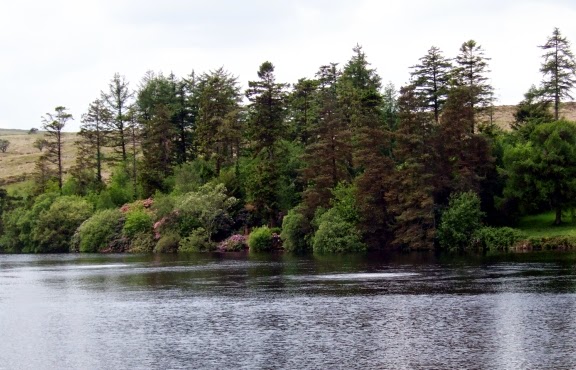
It was a quiet, grey west-country day: drifting mist obscuring the distant tors, ponies grazing with their foals, the rhododendrons at Venford Reservoir a dim, fading pink. As I reached North Hessary Tor the cloud thinned and a watery sun gleamed through and, by the time I arrived at The Bedford Hotel, the sky was clear and blue and it was promising to be another hot morning.


For more than forty years I’ve been meeting friends in the Bedford Hotel. When Charles was at Mount House School I’d take him there for exeats - when it was too far to drive back to whichever naval port we might be stationed at - and always with our golden retriever, Cassie, who was made very welcome at the Bedford. All our dogs have loved going to the Bedford; hurrying up the front steps in the expectation of seeing an old friend, settling under the table in the corner by the window, pricking ears or giving an appreciative thump of the tail when one of the staff appeared with a bowl of cold water.


This morning I was meeting Jean for coffee. Some people say that it’s not possible to make close friends when you’re old. It’s not true. I’ve known Jean for six or seven years; she came to help muck us out at The Hermitage but after a very short while she became a very close and special friend. What is that rare dynamic, that odd, instant recognition, that makes someone a ‘kindred spirit’? She’s much younger than I am, our life experiences have been quite different, but it isn’t relevant: we are on that same wavelength that surmounts those barriers.


We shared our news, we laughed a lot, we enjoyed the coffee – then we parted and I went to meet Carrye at ‘CafĂ© Liaison’ on Church Path.

I’ve known Carrye for forty-two years; we were young naval wives together. At Carrye’s wedding (our husbands were on the same submarine but I’d known her for only a few short months) Charles, who was then two and half, disappeared during the reception. When I found him he was sitting amongst a pile of her half-opened wedding presents thinking, no doubt, that Christmas had come again. Carrye was amazingly gracious about it! I am godmother to her daughter. We have a shared past embracing married quarters, Summer Balls, loneliness, silly in-jokes, divorce, bereavement . . . Lunch lasted for over two hours.


The journey home was through a very different landscape: a brilliant sky, the high rocks clear and sharp. I stopped below Cox Tor, reluctant to leave one of my favourite places and an inspiration for so many of the books, and bought an ice-cream. In the far distance I could see the gleam of the Tamar and, beyond that, the sea. How often I’d walked here with Charles and Cassie all those years ago.


I finished my ice-cream and as I glanced again towards the west I though I saw a small boy playing with a golden retriever, chasing a ball and running in the sunshine, but the sun was dazzling in my eyes and, when I looked again, they’d gone.

My best to you all and thank you for being such loyal readers.

Marcia


Last week I had to pop into our local garden machinery place and one of the chap's there has with him a young puppy. Neither of us could resist him so here he is chewing Marcia's scarf.