Friday, 22 February 2013

Trees in spring


Had I realised how tricky this was going to be I probably would not have committed myself to trees through the season which, inevitably, has to rely on photographs taken in previous years without a thought for this project.

There should be lovely pictures of rufus red leaves breaking out opaque bud covers (simply because these have had no change to start the photosynthesis which produces the chlorophyll which then gives the leaves their green colour).


The only picture I have that really shows this is of the sumac outside the kitchen door at The Hermitage and it is, therefore, a bit of a cheat.


Now these are young beech leaves which, because their bud covers are translucent, leap into the world the most gorgeous delicate green imaginable. Had I known I was going to write this blog I would have taken a picture in a beech woods looking up into the canopy just as the buds burst open to reveal these lovely leaves.


Where would spring trees be without flowers? This cherry stands – with others – in the churchyard of St Eustachious in Tavistock but the glory is short lived. Already the ground is carpeted in petals and within a few days they will all have fallen.


Blackthorn is a great delight: the flowers come out before the leaves but beware the long black thorns, the tips of which can break off so easily and are the very devil to prise out of the careless finger – thorns that will happily scoff at most gardening gloves.


Here is a photograph I took many years ago. It was this old, snow-covered blackthorn growing by the O Brook where the road crosses Saddle Bridge on Dartmoor that gave Marcia the name for the bridge leading to The Grange in The Dipper. Sadly, the blackthorn has long since washed away. I must admit this is not a spring picture: it was definitely winter and Marcia looks suitably bundled up against the cold.


Hawthorn – otherwise known as May – flowers after the leaves have appeared and somewhat later than the blackthorn. Does the old saying, “cast not a clout till May is out” refer to the hawthorn or to the month? The reason there are two pictures above is that Marcia and I couldn't decide which one to use so it seemed easiest to use both. Both are on Dartmoor – the one with the railings is at Venford Reservoir and the other on the open moor on Shapley Common.


This close up of the hawthorn flowers gives you some idea of how quickly things change when they get going. Some of the flowers have yet to open and others, having done their job, have already lost their petals.


Before we leave trees I thought I would include this avenue of copper beeches. They go nowhere and I have no idea why they were planted there but quite pleased that they were.


This weeks butterfly is a Silver-washed Fritillary Argynnis paphia. I forgot to give you the name last week: it was a Small Tortoiseshell Aglais urticae. I am only giving you the Latin names in case they are called something else where you live. In both cases I may have identified them incorrectly as this is noy an area in which I am at all expert.


The Blog Dog of the week is called Amber.

Friday, 15 February 2013

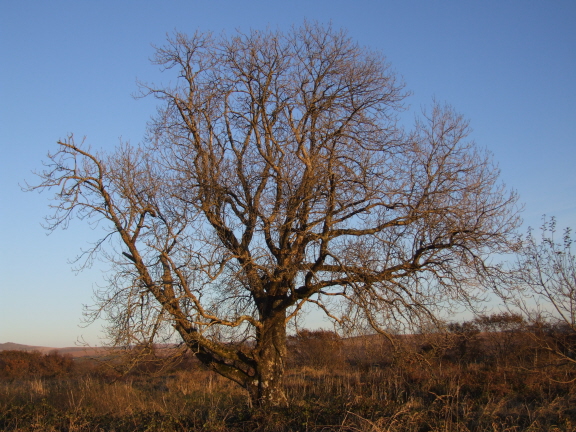
Trees in winter


So this week is about trees in winter. I am now back in my study having just enjoyed a fruit bun (Marcia had a pain au chocolat) and coffee in our kitchen, sitting by the window and looking at the ash trees growing in next door's garden just the other side of the wall. Will they be with us this time next year? We do hope so but with ash die back sweeping the country it may be a vain hope.

There is much talk about how to tackle global warming and the carbon emissions we create through the use of fossil fuels to meet our needs for power and to fuel our cars and so on. This doesn't help, of course, although one scientist produced a report (which I cannot now trace or I would give you a link to it) in which he calculated that in the USA carbon emissions are lower now than they were when the place contained millions and millions of buffalo. What few seem to mention (but those few do so with proof and passion and one of them is Sir David Attenborough) is that the real problem is the destruction of forest cover. This is in part through natural causes (hence the Sahara Desert, once tropical forest) and in part through logging. Either way there is a solution: plant more trees. Most of us can do a little bit of good in that direction as every single tree helps but it need concerted action to reclaim deserts and replace logged forests. Anyway, you can see why I feel trees are rather important and I hope that a few pictures will show that as well as being important they are beautiful.


Last week's solo photograph was taken in the snow and so was this one. What, without the snow, would be just a jumble of twigs is suddenly transformed.


More twigs, really, including a crow's nest used the summer before this was taken but not, for some reason, the one following and now all trace has gone.


This is one of my favourites. This is more than just a tree: it is host to a range of epiphytes such as mosses, lichens and ferns; to a large population of insects which means that it is a huge larder for many small birds.


Some trees are tall and elegant.


Others have a completely different outline (although they may be just as tall).


Some become little more than supports for ivy. Such a difficult plant, ivy. It can, does indeed, kill trees in the end by slow suffocation and I am hugely tempted to cut it away and give the tree a fresh lease of life BUT life is never that simple. Ivy provides birds and insects with shelter and food when both are in short supply – in the winter – as well as nesting sites – in the spring and summer.


Amazing how much difference the sun can make.


Helen suggested last week that we should look at butterflies and she is so right to say that they, too, are beautiful. I have not too many butterfly photos (probably not enough for a blog) but the ones I have can act as a tail piece until I run out. Is that fair enough?


Friday, 8 February 2013

Trees?


One of the problems with writing a blog every week is that the writer's year includes a period when next to nothing happens that can be shared with that writer's readers. You could call this the blogger's desert and we are now in that.

It happens after all the excitement of rushing around looking at places, watching Marcia listening to (and sometimes talking to) her characters, discussing with her where her thoughts are taking her and so on. In the old days (when Transworld published Marcia in the summer rather than, as now, in the late autumn) it included signings and other events triggered off by publication day.

Then comes the day when the computer is opened, a new document is created, it is given a working title and Marcia starts to write. Then, for day after day and week after week that is what Marcia does. Obviously there are still booky things going on but apart from sometimes tempting you all by mentioning the return of an old character, I am under strict orders to reveal nothing at all.

There are a number of good reasons for this. Once I allowed you to know the working title of a book – The Ginger Jar – only it was published under the title The Prodigal Wife. To this day we receive emails asking us when The Ginger Jaris going to be published. Then there are the times when a book takes a totally unexpected turn and some of the early chapters require changes. Then there are the very weird times when something has happened in an early chapter that really makes very little sense and neither of us know why it is there. Some few thousand words later on the puzzle is resolved and then, with the full picture there to see, Marcia returns to see whether or not something jars or seems out of place. That rarely happens (in fact I can't remember it ever happening) but usually there is something to be added which gives the scene greater depth and meaning.

And so it was that, just as I was really thinking “this whole blog thing was a very bad idea” your comments on last week's blog gave me an idea. Whether or not you will all like that idea is, of course, something else. Since you like photos, how about running a few photo themes during these few months when Marcia has her head stuck in her laptop? (That is a piece of imagery I could not resist.)

It seemed right to resolve this picture to monochrome
So for the next few weeks the theme will be trees. We will start next week with trees devoid of leaf in the depths of winter allowing us to enjoy their skeletal beauty, then look at them in spring, high summer and lastly autumn. Now all I have to do is to hope that I have enough photos in the files to meet that specification. What shall we choose for the next theme? Any ideas?

Friday, 1 February 2013

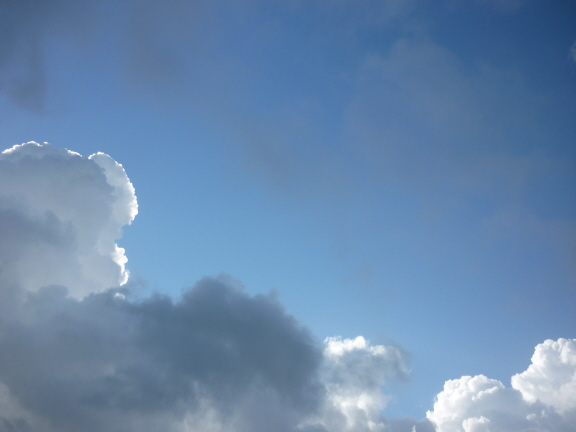
Clouds


On Wednesday we had to visit the hospital in Plymouth so that Marcia could have another check-up. You will be delighted to know that there are no signs that the cancer has returned.

There is one photograph that I want up on Dartmoor which requires really good visibility and so, the forecast suggesting that we would find just that, we set out from Plymouth to Tavistock for a quick cup of coffee in the Bedford Hotel before setting off up onto the moor proper - and into low cloud: thin cloud but cloud all the same. One day I shall get that picture, but that day was not last Wednesday.

On the way home there was a brief moment when the sun sent wonderful steaks of light on either side of a cloud. As so often happens, by the time I had grabbed a camera and it was ready to shoot, it was really too late: some of these light effects last for seconds and then they are gone. Anyway, here is how it was when I finally got myself organised.


Talking about clouds, did you know that there is a Cloud Appreciation Society? Well, there is and it has over forty thousand members. I am not one although I suppose I should be. Clouds are fascinating and here, on the peninsula that is the south west corner of England, we have a rapidly changing and often wonderful display of all sorts of cloud formations. Clouds are ephemeral: according to the Cloud Appreciation Society, the average lifetime of a cloud is only eleven but my observations suggest it is about twice as long.

Having said that, I have been known to watch fascinated as a cumulus cloud begins to appear out of a bright blue sky, grows and changes until, often quite suddenly, it starts to disappear and within a few minutes there is the bright blue cloudless sky once again.

For some reason, I find myself unable to resist the urge to take cloud pictures and so I have a large store of photographs taken in various parts of the south west which demonstrates just how variable they can be. Here are just some of them. Most, of course, are the result of luck: simply being in the right place
at the right time but some are planned – mainly sunsets since you know when they are going to happen and what the weather is like before you set out.


There is another missing photograph that has been bugging me for years. Here is the extract from Hattie's Mill:

James Barrington drove his second-hand Citroen Dyane jauntily through the narrow Devon lanes. James, born and raised in Dorset, was no stranger to high hedges, restricted visibility and inadequate passing places. Nevertheless, the recently purchased car was very precious to him and, despite the jauntiness, he kept a wary eye on possible damage to her paintwork. His mother had advised an introductory visit to Miss Wetherall at the Mill before he committed himself but refused his offer to come along for the ride and see for herself. She realised that James felt it incumbent upon himself to allay her motherly anxieties and, though she appreciated his offer, she suspected that he would prefer to take this step alone.
She was right. James was secretly relieved that she hadn't taken him up on his offer, enjoying this feeling of being out in the adult world at last; the owner of a car and a Mirror dinghy, in possession of a job and soon to be a householder. James, who had also been raised in the Anglican faith his father being a country parson, sang a tuneful snatch of the Te Deum and peered at a signpost that was all but obliterated by cow parsley and convolvulus. Abbot's Mill Creek 2 miles. He swung the wheel and headed down the narrow lane. The tall grasses and luxuriant summer growth leaned out to brush the car on each side and, as he slowed, he was aware of the scent of honeysuckle.
He rounded a bend, caught his breath and braked abruptly. Far below, the creek lay mysterious and still, its steep wooded banks clothed in a patchwork of green, the fields above - golden with standing corn or dotted with grazing sheep - swelling gently against the misty horizon. A soft haze, diffused with glowing sunlight, smudged the distant view but he could see a small sailing boat tacking its way up the river making the most of the gentle breeze and, his heart beating with a sudden excitement, James let in the clutch and followed the winding lane down to the head of the creek.

We know exactly where James stopped and I have wanted to take a photograph of that scene for about ten years. Unfortunately, every time we have managed to get there it is either raining or there is a heavy mist. Now we are again living much closer I might just have a better chance. We shall see.

Friday, 25 January 2013

Letters, emails and birds


Any email or letter that Marcia receives containing words such as, “I have never written to an author before but . . .” is, of course, a huge compliment. It is while she is writing that they are most important. I suspect that all novelists fall into one of two extremes: pretty unconfident or manically overconfident. I have yet to meet one who fits nicely in the middle – unlike us hacks who are only too happy to graze there (which is why we write such rubbishy novels when we are silly enough to try). All of which is a rather long-winded way of saying thank you to all of you who, without even knowing you are doing it, are – by keeping Marcia's confidence up there somewhere – making a very important contribution to “the next book”.

Those who were following my blogs before we moved will know that we used to get huge numbers birds in the “kitchen garden”. Here things are different. At any one time there are probably no more than four birds to be seen but we have a surprisingly large number of species dropping in and out.

We think the reason is this: over there we were the only “feeding station” for quite a distance and so brought in all the birds in the locality. Here we are one among many for most of our neighbours also put out feed. The result is that we have become just one of the stopping points on what we think is a regular patrol that the birds make around the neighbourhood. Because our kitchen and sitting room are on the first floor, we are level with the trees and so see species on a daily basis that we rarely saw before.


One such is a pair of blackcaps. Only the male has a black head, the mate's is rusty red. Nevertheless she is a charming bird, as you can see. I have yet to take a decent portrait of the male but will share it when that happens.


Then, and this was a great surprise, we discovered that we are on the feeding trail of two small flocks: goldfinches (above) and our old friends the long-tailed tits. Another daily visitor (or possibly visitors – we have only seen one at a time) is a goldcrest. These are even smaller than the wrens (also regular visitors) but a different shape being far less chubby.


The big problem is that these are so often either perching in the foliage or on some point where they are silhouetted against the sky – in both cases taking their portraits is not that easy. What I really want are birds like this collar dove who are willing to sit for a moment on the balcony handrail while I fumble around, find a camera and take a few photographs.


The birds that are really driving me insane are the jackdaws. They get up to the most fantastic (and funny) pranks but usually when I am without a camera as I am walking back from the shops. Then, as soon as I am ready for them, they fly away into the blue yonder and leave me getting bored and very cold.


I rather liked these two flying to their roost as the sun was setting.  Still, they will have to start building their nests soon and then I might have a better chance – or not, of course. We shall have to wait and see.


Friday, 18 January 2013

Oh yes we can!


We have had, for us, a very social week with two evening events.

Wednesday was first night for the village pantomime. It was great fun – despite the fact that I could hear not a word even though the hall does have an induction loop system (which was working quite well but my hearing is now rubbish). To see the youngsters – by which I mean the ones between, say, fifteen and twenty in that rather difficult and self-conscious period through which we all have to pass – prancing around the stage, encouraging the audience to join in and generally fooling around in the great pantomime tradition was wonderful. All very life affirming.

The second event was held last night and was the opening of an extension to the village library. This is housed in the old primary school which closed over twelve years ago when a new, and very splendid, school was built just up the road. Thanks to a huge and very well organised community effort, the buildings were bought by the village and are used by all sorts of groups – including the community library filled with donated books and run by a team of volunteers. Libraries have played a huge part in Marcia’s life and she was thrilled when she was asked to open the library just before we moved to the other side of the moor.

She was just as thrilled to be asked to open the extension and, despite the bitter cold with snow in the forecast, a surprisingly large number turned out to come and listen to her. Maybe it was because the village is in pantomime mode but, whatever the cause, the hall was constantly echoing to the sound of laughter as Marcia talked about the strange world of the novelist. After a brisk question and answer session – and a lot more laughter – Marcia cut the ribbon and as many as could squeeze into the library posed for a group photograph.

Photographs by Brian Dent
While we were asleep, it snowed. We both retain a somewhat childish approach to snow and so it was with a high level of excitement that I pulled back the bedroom curtains. I was not disappointed – the snow covered roof scape with the south Devon countryside in the background was as delightful as I had hoped. Obviously different from the snowy views from our other homes (as you can see from the photographs) it has a charm and beauty of its own. 
The view looking over Dartmoor from our house in mid-Devon . . . 

. . . and from the sitting room of our cottage on Exmoor.

If the visibility had been better - much better - you would have seen
Ugborough Beacon in the background.

One huge plus: where we were, the snow created total isolation which could be quite frightening whilst in this village, where we know so many of those whose snow covered roofs we can see, that is replaced by a great sense of companionship which is extremely comforting.


Friday, 11 January 2013

Writer's block


One of the expressions that we just do not allow in this household is “writer’s block”. Mind you, the fact that we don’t allow the expression does not mean that we do not experience the problem. I suffered from this last Friday and it was not until (and, if I am really honest, out of sheer desperation) that I typed the opening sentence while sitting in Rumour that the juices began, somewhat turgidly, to flow.

Marcia was in like state last Wednesday. Our mantra, “hit the keys, just hit the keys” was failing to do what was needed and so we turned to something else. After all, it would be an absolute waste of a day to sit in from of a blank screen staring at it equally blankly so, instead, I suggested we go up on Dartmoor and visit the scene of the crime or, at least, the places around which the book is being set.

The weather was glorious. The one day of decent sunshine that we have had for many a long week, and so off we went out through Ashburton (comes into the book) and up towards Buckland-in-the-Moor (which doesn’t – well, not yet) and veering off at Ausewell Cross and so up to the junction under Ripon Tor.

“Left or right?”

“How about a spot of lunch at The Dandelion?”

Seemed a reasonable suggestion (yes, in the book) and so I turned right and swooped down passing Haytor Rocks and so to the bottom of the hill where you will find The Moorland Hotel and it’s associated cafĂ©, The Dandelion.
We like this place, it has an assortment of different tables and chairs, including a very comfortable sofa (see foreground) and a rather unusual "wine glass" chandelier. 

They had suffered from flooding (not that surprising when you think about it) and the kitchen was out of action but there was carrot and coriander soup available which, with some hunks of their absolutely wonderful bread, was more than enough – especially as it was followed by a slice of horribly fattening lemon sponge.


Back up the hill – as you can see the sunshine had brought out quite a few people who had climbed to the top of the rocks – and so down towards Widdecombe. Just before the village, Marcia asked me to turn right and up to the Bonehills where we stopped and she went for a walk (see photograph of pensive author chatting to her characters among the piles of granite) before heading home.
Marcia on Bonehill Rocks.

Before you ask, I have no idea where the name comes from.

Yes, it worked. Inspiration having arrived, the next section of the book has been written. And it is raining again. And more rain is forecast for tomorrow. Then, or so they say, we shall see some snow. Well, that would make a difference and if it happens I will try and take some pictures to show you.

Before I go, our thoughts go to all of you in Australia. We hope you are kept safe from the fires raging there and remain so for the rest of the summer.