Friday, 13 September 2013

Here we go again!

“She has this small girl with her but it’s not her daughter. The mother is visiting someone in Australia – or New Zealand – or somewhere. Now all we have to find out is who this is, who is the daughter, where are they and what do they have to do with the story.” That isn't a quote but boils down what Marcia has been saying for the last few days into one simple sentence.

Simple? Well, not really. Still, that should be pretty easy – given the odd miracle or two – so why are we waiting? Well, we aren't  We are getting on with it. Between us we have driven about three hundred miles this week in trying to find the answer. Not that we've found it. All we know now is that there are a few places where they aren't and a few where the definitely are not. There is a subtle difference: in the first case it means that there is no sign that they are there whilst the latter means that this is so wrong that there would be no point in even thinking about it.

It is rather like when we were looking for a river. Not any old river but one particular river. If you remember we started looking in Cornwall and some weeks and many miles later found it by accident when we were up on Exmoor. Hey ho.

To be fair, searching around looking for Marcia’s people has taken me to places that I would otherwise not know exist. It has made me realise just what a wonderfully rich part of the world the south west of England is. Having spent a part of my life as a travelling trouble-shooter I have made brief trips to may countries and they all have some spectacular scenery and fascinating wild life. Mind you, I seemed to spend more time in their industrial estates than I did in their countryside but even so I took whatever opportunities I could to have a good look around. 

There are many I would have loved to explore more fully but it seems to me that there are two sorts of explorers in this world (and most people are neither). There are the ones that want to visit as many places as they can and then there are the ones that want to know one area as intimately as they can. I belong to the second group and every time we go off I will see something new, something I have never noticed before. Also, as the seasons revolve I shall know where to look for old friends – early snowdrops, shy violets, the first bluebells and so on right through the year – and in some ways this is just as important as finding the new.
Gorse, bell heather and ling (the paler of the heaths).
There is the whiff of autumn in the air. The wonderful lanes of spring have long since gone although there are a few places where there are good shows of wild flowers. Not entirely sure that I fully know why. On the open moors, the bell heather (Erica cinerea) is nearly over – what there is tends to be in the low clumps of gorse which is in flower at the same time – but the ling (Calluna vulgaris) lingers (and, before you ask, that is not why it has that name). It is also known as Common Heather or just Heather and is far paler than the bell heather but keeps going longer into the autumn.

' ...wild flowers behaving badly ...'
That’s about it for colour at the moment: the odd patch of wild flowers behaving badly and the gorse with the attendant heathers. Oh, and the rowan or mountain ash, which Marcia loves, is now covered in berries. 

Beech trees in the Exe valley in autumn

Meanwhile we have the proper autumn colours to look forward to. Nothing as spectacular as they see in Canada, of course, but there is nothing lovelier than the Exe valley when the beech trees prepare for winter.


Thanks to my brother-in-law, the puzzle of the moth has been solved. The problem was, of course, that we were looking at the underside so that the wonderful orange and red colours that adorn this animal were hidden. Anyway, all is revealed and what we were looking at was a Jersey Tiger Moth (Euplagia quadripunctaria). My thanks to the Natural History Museum for the following image.

Beau - well it had to be, didn't it?
Signings as of today (all signings last 1 hour):

Friday, October 11: Totnes Bookshop 2 pm
Saturday, October 12: The Harbour Bookshop, Kingsbridge 11 am
Friday, October 18: Bookstop, Tavistock 10.30 am
Saturday, October 19: The Torbay Bookshop, Paignton 10.30 am
Tuesday, October 22: Bookshelf, Saltash
Saturday, October 26: Waterstone’s, Plymouth 11 am
Saturday, October 26: Waterstone’s,, Roman Gate, Exeter 2 pm

To be scheduled: Waterstone’s. Truro and The Bookshop, Liskeard.

*  *  *  *  *

I rarely suggest that Marcia's readers would be at all interested in my other blogs but the one I posted today - Friday 13th - may be an exception. If you want to see what I am talking about, please CLICK HERE. This post is called 'Three Crows'.


Friday, 6 September 2013

The four dimensions

As I write, Marcia and – by extension – I are living in four dimensions. This has never happened before: astrology speak you might call this conjunction. I understand that the planets Venus and Jupiter are about to be (or have just been – this is not my subject) in conjunction and that this is terribly important. It seems it has something to do with being a gift from heaven so from where I sit it obviously applies to my spouse.

Our conjunction comes from a different place – a very different one. It is all to do with timing, of course, which is, I suppose, self-evident. Anyway, the four dimensions are Postcards from the Past (down on Bodmin moor with meanders off to Peneglos on the north Cornwall coast), The Sea Garden (set mainly on the banks of the River Tamar with trips to Tavistock), Indian Summer (I’ll come back to that one in a minute) and Untitled.
We are on Bodmin moor in Postcards from the Past.
This was the closest we got to the "feel" of Mellinpons,
home to Edmund and Wilhelmina St Enedoc.
As I said, it is all to do with timing. In a few weeks time Marcia will be carrying out the annual book-signing tour (see schedule below). Two books will be involved: the paperback of TSG and the hardback of PFTP. The first was written in 2010/11 and the second in 2011/12. Readers will want Marcia to talk about those books but those two worlds are, to her, a distant memory. Both of these dimensions will need some intense exploration before those signings if Marcia is to be able to deal reasonably intelligently with questions.
The River Tamar, the setting for The Sea Garden.
There is a nice story here about trying to remember books about which you are going to talk. Marcia was to be interviewed by Judi Spiers on Radio BBC Devon to discuss, or so she had been told, The Way We Were. She spent a few days boning up on the book and arrived at the studio at the appropriate time. Almost every room in the Exeter studios is fitted with a loudspeaker which keeps everyone aware of what is being broadcast. As usual, when one discussion ends, an announcement is made regarding the next talk and then a piece of music is played. So it was that moments before being live on air, Marcia heard the announcement, “Next we talk to one of our favourite authors Marcia Willett about her new book The Prodigal Wife.”

Marcia told me afterwards that her mind went completely blank – Prodigal Wife? – what Prodigal Wife? Needless to say she was the only one to know that she was in a state of panic: by the time the microphones were switched on she had pulled herself together. I have a feeling that this experience is one of the reasons she prepares so hard before these signings.
Here we are on Dartmoor again but not up on the open moors
but in the farmland  that adjoins them.
The third dimension was given a title earlier this week: Indian Summer. Finding titles for books is oddly extremely difficult. We have seen before that Marcia gives her books a “working title” that the marketing department rejects. This is fair enough: it is their job to sell books and they don’t want the title to turn people away but to attract them. Often Marcia is more than happy with the suggestions that are made although there are a couple of times when she has been less so. She always felt that the working title Stony Sanctuary was better that the published title Forgotten Laughter. The book, after all, was set in a granite long house on Dartmoor – a long house in which quite a few of the characters took sanctuary at critical moments in their lives. Anyway, the last couple of weeks have been somewhat overshadowed by the need to title the book that is now in production – and which I will be telling you all about next autumn.
This is in The Dandelion, a coffee shop that is attached to the Moorland Hotel at Haytor.
You will have to wait until 2014 to know why this is important.
Then, of course, there is the book now in the planning stage – dimension the fourth. This is when Marcia drifts away from everything else and enters almost completely into the world that she is about to create, as I have often described.

I suppose four should be five. Somewhere, usually on the periphery, there is a thing called “real life”. It tends to be considered of little importance although there are the usual requirements – food, clean clothes, etc – which do need a certain amount of attention.

This week’s blog dog lives in the United States of America and belongs to one of Marcia’s readers. Sally Gingerbread, as she is called is a cross between a Sheltie and a Chow.

Signings as of today (all signings last 1 hour):

Friday, October 11: Totnes Bookshop 2 pm
Saturday, October 12: The Harbour Bookshop, Kingsbridge 11 am
Friday, October 18: Bookstop, Tavistock 10.30 am
Saturday, October 19: The Torbay Bookshop, Paignton 10.30 am
Saturday, October 26: Waterstone’s, Plymouth 11 am
Saturday, October 26: Waterstone’s,, Roman Gate, Exeter 2 pm

To be scheduled: Waterstone’s. Truro and The Bookshop, Liskeard.


Friday, 30 August 2013

Lanes

This has been – and continues to be – one of the busiest weeks in our part of South Devon: the height of the summer plus school holidays plus the Royal Regatta at Dartmouth. These combine to make travel a bit of a nightmare: lots of traffic with few available places to park. It can be even worse in the lanes.


Not their fault, of course, but the visitors so often have little experience of driving in our country lanes which are often barely wider than a car – as you can see.

Then when you meet someone coming in the other direction there is a problem. One or other has to reverse into an area which is just wide enough for you to pass each other unless – and it happens quite often – there is such a place between you. Generally this will be a slight widening of the road giving just enough space to pass. The key is in those words “just enough”. Those of us who have driven here most of our lives are quite happy to stop only half an inch from a stone wall leaving a space to our right which is perhaps three inches wider than the incoming car. Likewise, if we are driving that oncoming car, we are more than happy with that. We pull in our wing mirrors and off we go. Those not used to the lanes are less content. Some pass by slowly and carefully but others just freeze and look helpless.
It's not just other vehicles: livestock seem to think they own the place.
They are probably right.
It is grossly unfair but then we say things like, “Come on for heaven’s sake. You could drive a bus through there!” in exasperated terms. This driver could not drive his or her car through there – let alone a bus. BUT if, like me, you rarely drive in large towns or cities, where the speed of the traffic switching from lane to lane with breath-taking confidence induces a sense of absolute terror, it behoves you to treat these drivers with courtesy: in their own comfort zones they are as confident and happy as are we in ours. Just as we fall to pieces when outside ours, so do they.

Thus, cursing under our breaths, we reverse as far as it takes to find a wider passing place, perhaps a gateway into a field or a road junction. We shall probably do this with complete insouciance never looking over our shoulders but with eyes flicking between our wing mirrors with the odd glance at the interior mirror. We are not showing off: reversing for long distances while turning your head round is somewhere between uncomfortable and downright painful so we soon learn to do it on mirrors alone.
They may be narrow but there are some lane verges that are delightful.
They are at their best in spring but still god here, three weeks ago.
However, we are probably breaking the law. The law does not encourage people to drive backwards down the roads and covers this with a simple regulation known as clause 203 of Law CUR reg 106: “You MUST NOT reverse your vehicle further than necessary.”

Putting aside the fancy name (I’m not quite sure what “Law CUR reg 106” means but it does sound like something rather distasteful) it poses a question. The capital letters are enshrined in that law, by the way, and they are sometimes printed in BOLD. The problem is contained in the word “necessary”.

If there really is enough space but one driver has insufficient confidence to drive through it, does that make it “necessary” in the eyes of the law for the other driver to reverse one inch let alone (as sometimes happens) a few hundred yards? Most of us don’t give this a thought, we do what we deem to be “necessary” and most of us do it cheerfully and then wave happily at the other driver as he or she passes by. Come to think of it, that driver is probably an accessory to this crime.

There are times – are there not? – when the law is an ass.

Still, come the end of next week after the schools start their autumn terms we shall all be back to normal. We shall still meet others in the lanes but when two “locals” meet they somehow size up the situation and quickly come to what feels like a mutual decision as to the best way to solve the impasse. Anyway, if you are not that happy in these narrow lanes there is no need to use them: they rarely lead anywhere that isn’t served by quite decent roads.

Last evening, Marcia and I went for a walk beside the River Avon at Shipley. 

We were lucky to see the dipper - a long was away as usual but always a delight.

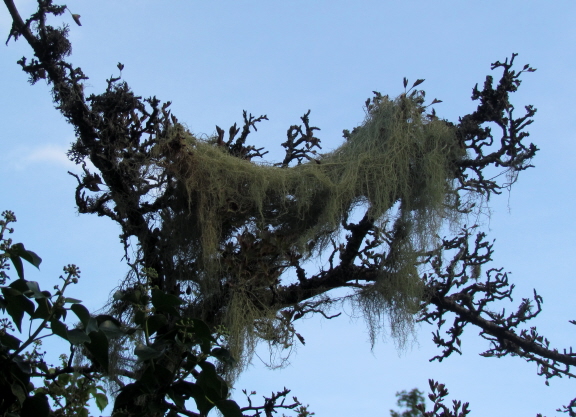
It was Marcia who spotted this lichen draped over a thorn bush.
No question but that autumn is nearly on us when the rowan berries appear.
Chadwick aficionados will remember that it was here that Miles suffered a stroke so perhaps I should add that there was no such disaster yesterday.

Meet Filo.


Friday, 23 August 2013

Dartington Hall

Yesterday we popped over to Dartington Hall to have coffee with a couple of friends in the Round House. In the old days we would have gone to the White Hart but now Dartington Hall hosts more – and more popular – events they have had to increase their catering capacity. It is sad to see the White Hart so changed but the new Round House is delightful.
The Gate House. The Roundhouse (see picture below) is to the left.

We used to go there quite often before we moved to the other side of Dartmoor but this is the first time since we came back. Marcia has been to the Cider Press – a shopping complex and restaurant run by the Dartington Hall Trust – a few times to meet up with friends but not to up to the hall itself.
The entrance to the Great Hall (this and the next picture taken by B Rochard)
These names should be familiar to you. Caroline and Prue used to pop over from The Keep and it was in the White Hart that Jolyon confronted his mother in The Prodigal Wife.
You can stay in the rooms overlooking the courtyard.
The original hall was built at the tail end of the 14th century by John Holland, Earl of Huntingdon and Duke of Exeter. He was half brother to Richard II who was deposed by Henry Bolingbroke – Henry IV – and tried to lead a rebellion to reinstate Richard. This rebellion failed and John Holland was executed and his lands, including Dartington, became the property of the crown. Sir Arthur Champernowne, Queen Elizabeth’s Vice-Admiral of the West, acquired the Hall in 1559 and the family lived there for the next three hundred and sixty six years.
When the weather is nice there is no better place for lunch than under the canopies outside The White Hart 
When Leonard and Dorothy Elmhirst bought the estate in 1925 the hall and most of the other buildings were derelict. They met when Leonard was studying agriculture in the USA at the Cornell University where he was elected to be President of Cornell’s Cosmopolitan Club (for foreigners). Finding that the club was burdened by huge debts he embarked on some money-raising activities which brought him into contact with Dorothy Whitney from Washington DC.

The Elmhirsts wanted Dartington to become a centre where the arts could flourish and that, together with some additional aims, remains true under the ownership and management of the Dartington Hall Trust. Click here for their web site.

The Ways With Words festival is held here (Marcia has spoken at that festival a few times) and it is probable that the artistic influence of Dartington helps to ensure that Totnes remains to this day to be the most inclusive town I have ever known – you meet all sorts here and all are welcome.

On the way home we took to the lanes although we used proper roads going over to ensure we didn’t get lost which could have made us late. It may sound strange that we can get lost here but this area is criss-crossed by a multitude of lanes all of which look much alike. When we lived in Avonwick we used to buy runner beans grown in four huge greenhouses on a market garden somewhere in that part. Now, over a decade later, we have been unable to find it. Even if the market garden has closed down, I am reasonably certain I would recognise the big bungalow built near the entrance.


So I make no apologies for getting lost although, as you well know, we are never really lost. How can we be when we are to the south of the A38, north of the sea and somewhere between Exeter and Plymouth. Not lost – just a bit wumbled which inevitably reminds me of Roly the unwumbler in Echoes of the Dance.

Friday, 16 August 2013

Are we sinking?

Last week our son popped down to see us for a couple of days which was, as always, a great delight. However . . .

Most parents would agree that there are certain episodes when their young are young (if you see what I mean) that are best forgotten. Charles decided over lunch to reminisce about one such occasion.

We had bought a launch – an open boat with a covered foredeck (useful for stowing shopping and so on), a short mast (generally useless but fun for hanging flags from), a folding canvas canopy rigged abaft the mast under which two people could shelter from the elements and a rather good Mercury outboard that enabled us to go both forwards and backwards (or ahead and astern if you prefer). The boat was on the shore beside the River Yealm at Noss Mayo. Our ketch was in the Kingsbridge estuary. The obvious thing to do was to ask the previous owner to put her afloat, cadge a lift down to Noss Mayo and bring her back by sea. This was known as “Plan A”. There was no “Plan B”.

The whole journey would have been in the order of twenty miles which at our cruising speed of about four knots would take about five hours. We had all the important things with us: provisions and the means to make coffee; ample fuel for the outboard; sunglasses (it was high summer) and spare sweaters in case it turned chilly.

The launch (it never did have a proper name) had been ashore and being a clinker built wooden boat needed a bit of time to “take up”. These boats keep the water out because the overlapping boards are held together with copper rivets (or “clenches” as they used to be called and from which the name derives). Riveted together when the wood is dry. Only when the timbers become wet (or “take up” moisture) and swell does a clinker built boat become watertight. Really the launch should have been in the water for a couple of days more before we set out but . . .

The crew: two landlubbers and (right) an old sea dog - Boy.
We were about half-way. The sun continued to shine, the sea was almost flat and there was virtually no wind. The coast of south Devon was slipping past looking, at that distance, utterly beautiful. Then one of my two landlubbers noticed that water had begun to seep over the bottom boards (the flat bits of wood inside the hull on which you stand). Panic. Needless and totally unnecessary panic. Where was the pump? We haven’t got one. Where was the baler  An inspection in the stern locker soon answered that: we haven’t got one.
Not quite the right part of the coast but this is much the same
and the shore is about as far away as it was that day.
I pointed out the facts. The boat was gradually taking up and the rate at which she was leaking was slowing down: during the first half of the journey we had taken in less that three inches of water: we wouldn’t sink unless we took in another twelve at least: there was nothing to worry about.

The crew continued to worry – quite a lot. Needless to say we made it, safe and sound.

But Charles has never forgotten. We were talking about the joys of boating when he decided to revisit that trip. There was nothing worth saying so I didn’t say anything.

‘Good heavens!’ said Marcia. ‘That’s the first time I’ve seen you lost for words.’ She was right, I was.


Claire Rudkins – she blogs at “Less is More (I hope!)” sent me a photograph of a moth the other day. It landed on her window in Exeter and, as you can see, we are looking at the underside of the wee beastie. Claire wondered if I could identify it. Basically I have failed. Someone has told Claire that it is a Vapourer Moth. I think not. This moth (Orgyia antiqua to give it its proper name) is odd in that the female is flightless and the male has very distinctive feather-like antennae whilst the moth in the picture has long, slender and unfeathered antennae. So, what is it? I won’t bore you with my investigation save to say that there are only 2 out of the 2,700+ moth species in the UK that strike me as possibles. Both present problems. One has never been seen in the south west and the other shouldn’t be around at this time of the year. Hmmm. Any ideas, anyone?


Our blog dog this week spends much of his time on an old Humber Barge in the River Dart. Hardly surprising, therefore, that he is called Storm. I should add that be came from Animals in Distress of Ipplepen (not far away) who rescued him after a very traumatic start to life. Now, after four years of patient and loving care, he is a happy and very friendly person.


Friday, 9 August 2013

The 100th Friday blog!

There are all sorts of reasons for working. Two old saws come to mind: keeping the wolf from the door and keeping a roof over one’s head. Some authors write commercial output – which they may well call “wolf scarers” – while also writing what they really want to write even though it does not earn that much.

I seem to remember that this was true of Bruno Trevanionn. We meet him in The Golden Cup. His, uncommercial, passion was to write about the work of Joseph Bazalgette (a relation) who was responsible, as Chief Engineer of London’s Metropolitan Board of Works, for an incredible networks of drains and sewers under London – much still in use today. He did much else besides, embanking much of the River Thames and building a number of bridges.
The famous Butterwalk in Dartmouth
I have a fellow feeling with Bruno on this subject. My grandfather moved from Kent to take the post of Engineer and Health Inspector for the then Royal Borough of Dartmouth and it was he who completed the embankment of the River Dart which resulted in the draining of a creek known as Coombe Mud and the creation of a new public space now called Coronation Park. Prior to this there was a row of cottages, Coombe Terrace, at the head of the creek and these remain today. If you drive down into Dartmouth by the new main road you will find them on your left as you skirt round Coronation Park.
Fairfax Place and, below, detail of the panels seen above the red car.
None of this has much to do with Marcia’s writing although she is fairly confident that the next novel to be tackled will be set in Dartmouth and the town is much in my mind at the moment. It has changed dramatically over the years. Indeed, it has changed dramatically during my lifetime. Much of the industry that kept the place alive has gone to be replaced by tourism. There is an industrial estate nearby but little is now made in the town itself. Gone are the boatyards, the pottery (Dartmouth Pottery is still made but not in Dartmouth), the blacksmith, the gas works and the generating house which supplied the town with electricity – 400 volts DC was produced which was, literally, lethal. All of these places are tangled up with my family history and so I can well understand why Bruno was fascinated by that of his.
The Cherub now a pub but once a merchant's house
One of the reasons that Dartmouth is so popular with the visitors is that it retains many of the medieval buildings for which it is rightly famous. We forget that they stand simply because the place was too poor to replace them until the wheel of fortune turned and we came to realise that these beautiful old treasures needed to be preserved.
As always, it is the river that is at the heart of Dartmouth
Marcia’s characters will probably be living in something rather more modern and definitely more convenient. Throughout history Dartmouth has swung between riches and poverty many times. Generally speaking it has been the sea that has brought the riches – as in 1592 when the famous Madre de Deus, a Portuguese treasure ship which had been captured was brought into the harbour. Much of her cargo “disappeared” before the arrival of Sir Walter Raleigh to take possession in the name of Queen Elizabeth.
The Britannia Royal Naval College as it is today
I have mentioned the Embankment: much of the earlier work that was carried out to embank the river and reclaim the muddy shores was done by French prisoners during the Napoleonic Wars and it was shortly after that war that the decision was taken to create an academy for training officers for the Royal Navy at Dartmouth. Initially this was housed in an old wooden warship, HMS Britannia which is why the present establishment is known as Britannia Royal Naval College – and I am sure you will all remember the part that that establishment played in Those Who Serve and, later, in the Chadwick Trilogy.
I have to confess that I cannot find the name of this handsome fellow.


Friday, 2 August 2013

Weather

For the last two years or so, the weather has been . . . unusual. There seems to be a lot more energy in the systems that drive weather and I am sure this is not just here in the UK but pretty much world wide. Everything seems magnified. There are periods of drought followed by torrential downpours and flooding. In winter the temperatures drop to record lows and in summers they soar to record highs. How much of this is natural and how much is caused by what we all do, I really don’t know. What I do know is that the weather forecasters seem to be finding it harder than ever to offer accurate predictions despite having far better information these days.


It is this that caused all the problems on Wednesday. We had been expecting a nice sunny day after some pretty miserable conditions that followed the super-hot June and into July. So we made plans. Plans that were all based on the sun shining. Plans that included visiting parts of the coast and taking some good photographs and video of people enjoying themselves on the beaches, cavorting merrily in places such as Dartmouth and generally having a happy holiday.


The sun obviously had not been listening to the South West of England’s weather forecast. It spent the entire day sulking behind a pall of low cloud from which drifted down a gentle drizzle which soaked everything and everybody.


Still, the British are a stoical lot and they were determined to make the best of things: some even seemed to enjoying, cavorting and happily holidaying. I must mention one group, two chaps with their wives. Suddenly (and luckily just as we were pulling to a halt) the windscreen wiper in front of me flicked into the air and landed on the bonnet. Hastily switching off the wipers – and the engine – I hopped out to take a look. Everything seemed to be there: the wiper itself and a little gadget with which it is attached to the wiper arm. The only problem was I had no idea how these things fitted together and that is where this cheerful quartet came in.
Taken on a better day: the boatfloat and, below, Foss Street.
I asked the nearest chap whether he had any ideas. No, he said, but my chum does. He called the other chap over and he had a look. Obviously he knew what he was doing and he had a go but it was his wife who, I think she was losing patience, took the situation in hand and soon all was right as rain. We saw them again later in the morning – now in Dartmouth – and all waved cheerfully as they passed.


Still, the week wasn’t a complete washout. Marcia is pretty sure that Dartmouth will feature in the next book so I took a few photos so that she could remember what it was like in the damp and gloom. This was, of course, completely unnecessary as we lived there many years ago and know it in all its moods. Even so, I have printed some off in a montage so that they can join the others she has at hand when she is actually writing.


Staring into the middle distance in the hope of something good arriving is Mitzie.